








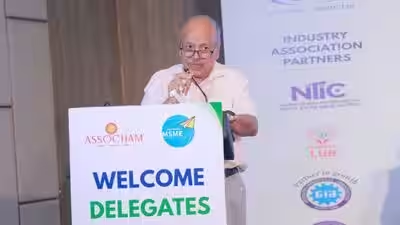
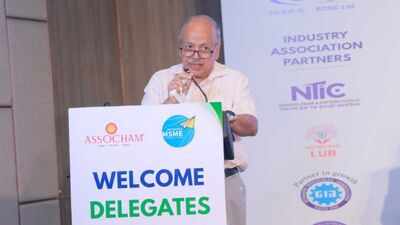
GURGAON: Auto component manufacturers, particularly micro, small and medium enterprises (MSMEs), need to reposition themselves to serve the electric vehicle (EV) ecosystem as India’s EV market expands, government officials and industry experts said at an industry conclave in Gurugram on Friday.Speaking at ASSOCHAM’s EV Ancillaries and Auto Components Conclave 2026, Sanjeev Chawla, additional development commissioner, MSME DFO, Karnal, said EV penetration in India currently stands at around 8.5%, or nearly 50 lakh vehicles, and is expected to reach 30% by 2030, creating significant opportunities for domestic component manufacturers.He urged MSMEs to explore opportunities across the EV value chain, including battery management systems, suspension systems, wiring harnesses, switches and brushless DC (BLDC) motors, while investing in innovation, intellectual property and patent filing to remain competitive.Chawla said long-term growth would depend on innovation, quality improvement through lean manufacturing and Industry 4.0 practices, and building an indigenous EV supply chain instead of relying on imports.Highlighting the technological shift, MK Sardana, coordinator, Department of Industries and Commerce, Haryana, said a conventional internal combustion engine (ICE) vehicle has around 2,000 moving parts compared to about 18 in an electric vehicle, underscoring the need for component manufacturers to diversify.He added that batteries account for nearly one-third of an EV’s cost and that localisation of battery manufacturing should be a strategic priority.Sardana said Haryana’s EV Policy, launched in 2022, will remain in force until 2027, while a dedicated MSME policy is expected within a month. He also highlighted the recently launched Invest in Haryana 2026 umbrella policy, under which electric mobility has been identified as a priority sector.Ajay Mohan Goyal, joint director, Department of Industries and Commerce, said Haryana accounts for nearly 50% of India’s passenger car production and around 60% of motorcycle manufacturing, placing the state in a strong position to lead the EV transition.The conclave also focused on financing for MSMEs, localisation of EV components, export competitiveness, technology adoption, skilling and sustainable manufacturing, with experts saying the shift to electric mobility presents significant opportunities for India’s traditional auto component industry.