









Most families will keep one eye on the clock on Tuesday, 20 October, because Vijayadashami worship has a fixed afternoon window, and it is short. As per the Hindu Panchang for New Delhi, Dashami Tithi begins at 12:50 pm on 20 October and ends at 2:11 pm on 21 October. The main observance falls on 20 October across most of North, West and Central India, and Bengal marks Bijoya Dashami on 21 October. Here are the timings, followed by the full puja method.
Timings for 20 October (New Delhi)
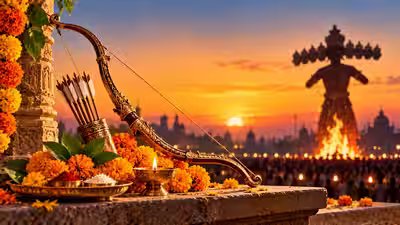
The Vijay Muhurat runs from 1:59 pm to 2:45 pm, which gives 46 minutes. This is the preferred slot for Aparajita Puja and Shastra Puja. The wider Aparahna puja time runs from about 1:14 pm to 3:30 pm, and families who cannot reach home by two o’clock can still begin inside that stretch. A few sites list the start as 1:13 pm or 1:20 pm, so 1:15 pm is the safe earliest point.The Shubh Muhurat for the festival is this afternoon window and not the morning. Navami ends at 12:50 pm, so anything done before then still belongs to the previous day. Midday slots such as Abhijit fall before Dashami begins, which is why most priests do not use them for Vijayadashami worship. For a choghadiya check, enter the city on a panchang site and pick a slot inside the Aparahna.Ravan Dahan takes place after sunset, close to 5:40 pm in Delhi, though organisers set local times. Shravana Nakshatra is active through the afternoon and ends in the evening, and many priests treat it as a supporting factor.Please remember that timings shift by several minutes from city to city.
Complete Puja Vidhi
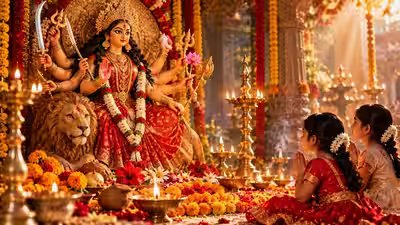
Begin with a bath and clean clothes. Wipe the puja corner, draw a small rangoli and place a fresh cloth on a raised seat. Sit facing east or north-east.Set a picture or idol of Goddess Durga, and Lord Rama if the family worships him, on the cloth. Light a ghee lamp and an incense stick. Place a kalash filled with water, topped with mango leaves and a coconut, beside the lamp.Next comes Shastra Puja. Gather the tools of daily work: books, pens, a laptop, musical instruments, kitchen knives, farm tools or vehicle keys. Wipe each one and apply a dot of roli or sandalwood. Offer flowers and a pinch of rice. The idea is to thank the instruments that support a livelihood.Then perform Aparajita Puja. Many households draw an eight-petal lotus with flour or rice on a clean plate. Place the Goddess in the centre, with Jaya and Vijaya on either side. Offer sandalwood, red flowers, fruit and sweets. Chant “Om Dum Durgayai Namah” or the family’s preferred Durga mantra, 21 or 108 times.In some regions, the next step is Shami Puja. Worship the Shami tree in a nearby temple or garden, and bring home a few leaves. Where Shami is not available, Apta leaves are exchanged as a gesture of goodwill. Elders give the leaves to younger family members, along with a blessing.Close with an aarti, then distribute prasad. Take a moment for gratitude before stepping away.
Navratri Closing Rituals
Families who kept the nine-day fast often break it after the puja. Kanya Pujan, where nine girls are fed and honoured, is usually held on Ashtami or Navami, but some households complete it on Dashami. Follow the family custom.The kalash installed on 11 October is respectfully moved after the puja. The water is sprinkled around the house, and the coconut is shared as prasad. The barley shoots, grown from the seeds sown on the first day, are carried to a river or planted in a garden or pot. A few shoots are tucked into the household’s cash box or prayer shelf as a sign of growth.
Regional Trends
Bengal and Odisha observe Dashami on 21 October. Idols of Durga are immersed, married women take part in Sindoor Khela, and neighbours exchange sweets. Karnataka and Kerala follow their own temple and state calendars, so Mysuru’s festival schedule may differ from a city in the North.Families travelling on 20 October can do a short puja before departure or at the destination, as long as it is done within the Aparahna window.
A Quick Plan for the Day
Keep the puja items ready the night before, so there is no scramble at lunch. Finish the household’s meal by noon if possible. Be seated by 1:50 pm, and start the main puja at 1:59 pm. After the aarti, step out for Ravan Dahan if the family attends one.Small, steady preparation turns a rushed afternoon into a calm and meaningful one.