








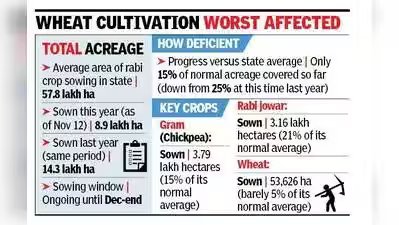
Pune: Maharashtra’s rabi sowing has fallen behind last year’s pace by 5.40 lakh hectares, with drought and inadequate soil moisture forcing farmers to delay cultivation or restrict sowing to fields with assured irrigation.According to state agriculture department data, sowing was completed on just 8.92 lakh hectares—out of the state’s average rabi area of 57.80 lakh hectares—as of Nov 12, compared with 14.32 lakh hectares during the same period last year, marking a nearly 38% year-on-year decline.State agriculture commissioner Suraj Mandhare told TOI, “Due to severe water scarcity and deficient retreating monsoon rains, rabi sowing in Maharashtra has been hampered. Farmers are prioritising jowar and chickpea (gram) over water-intensive wheat and sugar cane. Sowing activity is still going on and will continue until the end of Dec.”The major crop areas are gram (43%), jowar (30%), wheat (20%), and maize (8%), he said.“A reduction in area is expected for wheat. We are prioritising and promoting the economical use of available water and ensuring fodder availability by providing subsidised seeds for crops like jowar, maize, and gram,” added Mandhare, who is monitoring the situation closely.The significant gap highlights the impact of this year’s deficient rainfall and prolonged dry spells on the state’s winter cropping season.Although reservoirs, lakes, and wells had adequate water following the initial phase of the monsoon, the subsequent dry spell and inadequate retreating monsoon rainfall affected soil moisture. Consequently, several farmers have been unable to undertake sowing even where they had initially planned rabi cultivation.The shortfall is particularly concerning in drought-prone districts of Marathwada and western Maharashtra, where farmers depend heavily on residual soil moisture and limited well irrigation for winter crops.Crop-wise figures show that farmers are prioritising relatively less water-intensive crops. Rabi jowar sowing has reached around 3.16 lakh hectares, accounting for 21% of its average area, while gram cultivation stands at approximately 3.79 lakh hectares, or 15%. Maize has covered around 82,569 hectares (22%).Wheat, which requires assured irrigation at critical growth stages, has recorded particularly slow progress. Its sowing stands at just 53,626 hectares, barely 5% of the average area of 11.80 lakh hectares, officials said.Agricultural experts said the availability of soil moisture and assured irrigation would determine the final rabi acreage rather than the calendar alone. Farmers without sufficient water are increasingly reluctant to invest in crops that require multiple irrigations.“There is no soil moisture in several jowar-growing tehsils. We cannot even recommend sowing this season,” Solapur district agriculture officer S. Bhosale said, highlighting the worsening conditions in one of Maharashtra’s major rabi jowar belts.Agricultural universities have also advised farmers to prioritise low-water crops such as gram, rabi jowar, and safflower, and to undertake the cultivation of wheat and other irrigation-dependent crops only where protective irrigation is available during critical growth stages. They have recommended short-duration varieties and water-saving irrigation methods such as sprinklers and drip systems.The agriculture department, however, expects sowing activity to continue until the end of Dec.“The coming weeks will therefore be crucial in determining how much of the remaining average area can be brought under cultivation. However, it is expected to be significantly lower because there is no possibility of additional water,” said another senior agriculture official.Experts caution that delayed sowing could also affect crop productivity, particularly where farmers miss the optimum sowing window.“Even if additional sowing takes place in the coming weeks, the 5.40 lakh hectare gap compared with last year reflects the scale of the drought’s impact on Maharashtra’s rabi season,” added the official.