








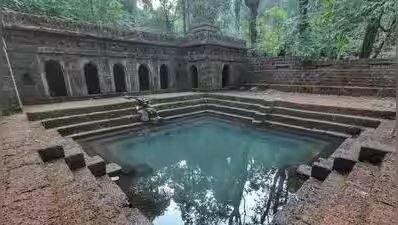
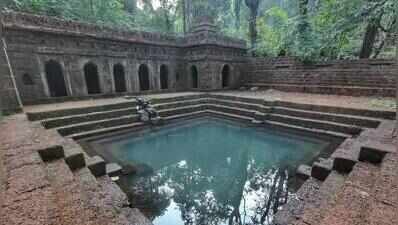
Pune: With drought gripping several parts of Maharashtra, the govt is turning to centuries-old water conservation structures, planning to rejuvenate 75 historic stepwells (baravs) across the state to revive traditional water sources and create employment for local communities.The state archaeology department has earmarked Rs 25 crore for the first phase of the project, with restoration work scheduled to continue until the end of summer.The initiative will cover historic stepwells in different regions, including drought-hit Marathwada and Vidarbha, where the revival of these traditional water bodies could provide an additional source of water for local communities.The decision was taken at a recent meeting in Mumbai. Subsequently, officials from the department’s seven divisions have been asked to identify stepwells in their respective jurisdictions and submit proposals for their rejuvenation.Tejas Garge, director of the Directorate of Archaeology and Museums, said, “These wells are unique and have historical importance in their respective regions. The main objective of this initiative is to undertake water conservation work. The work will be executed by local people, thereby generating employment for them. In the first phase, we plan to rejuvenate 75 such wells. This work will continue until the end of summer. The estimated expenditure for the inaugural phase is Rs 25 crore.”These stepwells are generally large structures, often with natural springs, and many were constructed using stone during the Maratha Empire. However, over the years, several have deteriorated due to weather and environmental factors. Despite their condition, some continue to provide water throughout the year.Officials said a single stepwell could potentially meet the drinking water requirements of an entire village, highlighting the enormous water storage capacity of these historic structures.Vilash Wahane, assistant director of the archaeology department and head of its Western Maharashtra division, said officials had identified 25 such stepwells across Pune, Satara, Sangli, Kolhapur and Solapur districts. “We will desilt and undertake extensive maintenance of these wells. Most of them are deep, well-constructed structures with the capacity to store crores of litres of water. Therefore, this work is extremely crucial for local communities, particularly during the ongoing drought crisis,” Wahane said.The square stepwell at Walur, along with one each at Arvi, Charthana and Pingli, all located in Parbhani district of Marathwada, is among the prominent examples. Other notable structures include Bajirao Vihir in Satara district, Girnare in Nashik district, Manchar in Pune district and Mahimapur in Amravati district.Stepwells are multi-storeyed ponds or wells commonly found in western India. Historically, they served as important water storage bodies, supplying water to entire villages and towns. Apart from their practical utility, they also held social, cultural and religious significance. However, over time, many became redundant, fell into disuse and were gradually forgotten.Rohan Kale, an explorer and history enthusiast who has been documenting and preserving these structures across the state, said his research had revealed the enormous historical spread of stepwells in Maharashtra. He said several of these historic structures had either been destroyed or neglected over the years. Some were demolished during road-widening projects and other urban development activities, while others had been turned into garbage dumping sites, further eroding their historical and cultural value. “This makes the loss of their historical and cultural value even more unfortunate. Through this campaign, the govt will not only create awareness about these historically important structures but also underline their significance as traditional water conservation systems. That is how people will remember and respect these wells in the future,” Kale said.The stepwells documented by Kale also display fascinating architectural designs, with structures shaped like the letters L, Z, U and V. Many feature one-sided entrances, allowing access to different sections of the structure. During his study, he came across the British Gazetteer published in 1881, which documented 5,990 stepwells in Satara, 4,700 in Solapur, 3,500 in Pune and 1,500 in Ahmednagar. Most of these structures were believed to belong to the Yadava or Chalukya periods. “This made me think that if there were around 15,000 stepwells in just four to five districts of Maharashtra, there could be more than 50,000 across the entire state. With this idea in mind, I began mapping these stepwells,” Kale said.Indologists said stepwells had played an important role in water management since the Harappan period and continued to hold relevance even today because of their efficient water management systems. These structures were often developed around catchment areas of perennial water streams and underground water channels, with access to water provided through flights of descending steps, they said.Many of these structures have now sunk into the ground or become partially buried due to years of neglect and natural processes. Apart from their water storage utility, stepwells also served as important social, cultural and religious bonds, said experts. They added that their sturdy construction also enabled many of them to withstand earthquakes, reflecting the engineering knowledge and water management practices of earlier periods.