








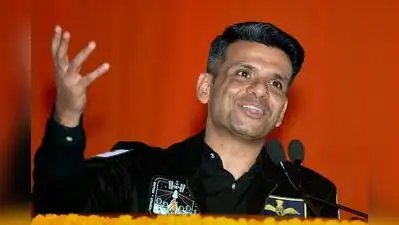
Chandigarh: When Group Captain Shubhanshu Shukla became the first Indian national to travel to the International Space Station (ISS), he also became an example of perseverance and courage for the younger generation.Recalling the anxiety he experienced during rocket launch despite years of preparation, he admitted wondering, “Did I take the right decision? Why am I sitting here?”His advice to youngsters is to focus on one question: “What can I do now? What is under my control now?” He emphasised that anxiety is natural, but focusing on what lies within one’s control and taking one step at a time helps overcome uncertainty and move forward.The power of perseverenceAnother powerful example of persistence came through his account of American astronaut Peggy Whitson, who commanded his mission. Shukla recalled that Whitson had faced repeated rejection when applying to become an astronaut. She was rejected nine times before finally being selected on her tenth attempt, at the age of 39.Today, with 695 days spent in space, she holds an extraordinary record of experience.For the young audience, Shukla’s message was that rejection does not have to be the end of a dream. Sometimes, the difference between giving up and making history is simply the willingness to try again.Shukla also recalled how, during his initial days in space, he instinctively held on to objects, fearing they would fall. The habit followed him back to Earth when he casually let go of his laptop, forgetting gravity would pull it down. The incident highlighted how deeply habits shape our thinking and behaviour.When there is no solution, become the solutionAmong the most fascinating parts of his journey were the scientific experiments he conducted aboard the ISS. Shukla explained how the absence of gravity changes familiar physical and biological processes. Water forms floating spheres, flames behave differently, and even the human body undergoes significant changes.He spoke about experiments involving stem cells and the possibility of using supplements to prevent muscle loss in space, research that could eventually benefit people suffering from muscle-degenerative conditions on Earth. Another experiment involved growing microalgae, which could offer nutritional benefits and potentially serve as a source of biomass for fuel.But it was a seemingly simple experiment that offered perhaps the most memorable lesson in problem-solving.As part of a research project, Shukla had to collect samples from experimental bags using a syringe. On Earth, separating air bubbles from liquid in a syringe is relatively simple, in space, however, this familiar technique does not work because gravity cannot separate the air from the liquid. With 36 samples to collect and no opportunity to repeat the process, he had to find another way.Their solution? If there was no centrifuge available, he would become the centrifuge.Holding the syringe at arm’s length, Shukla spun himself around to create the force needed to separate the air bubbles. Each sample required around 10 to 12 turns, adding up to approximately 400 turns across the entire exercise.The experience, he explained, reinforced the importance of problem-solving skills. Sometimes the challenge itself is unfamiliar and there is no ready-made answer. What matters is the ability to assess the situation, think creatively and find a way forward.Be comfortable with being uncomfortableShukla urged youngsters to embrace discomfort as an essential part of achieving something extraordinary. From wearing cumbersome space suits and undergoing hours of simulations to adapting to the physical and psychological challenges of life aboard the ISS, an astronaut’s journey is anything but comfortable.He highlighted how microgravity causes fluid shifts, temporary height gain and rapid muscle loss, necessitating two hours of daily exercise. Even returning to Earth is challenging: after travelling at 28,000 kmph, the spacecraft must slow down for re-entry, with temperatures outside reaching nearly 4,000 degrees Celsius.Recalling how he struggled to walk, sit up and even felt the weight of his eyelids after landing, Shukla emphasised that adapting to discomfort is part of pushing boundaries and moving forward.Shukla highlighted India’s growing space ambitions, its evolving space policy and the rise of over 450 space-related startups. With the country aiming to send an Indian astronaut to the Moon by 2040, he urged students and parents to explore emerging career opportunities in the sector, stressing that the next generation must see this not merely as an opportunity but as a responsibility.Recalling Rakesh Sharma’s iconic “Saare Jahan Se Achha”, he concluded with a video of India captured from the ISS, showcasing its illuminated cities, the lightning in Himalayas and a spectacular sunrise.