






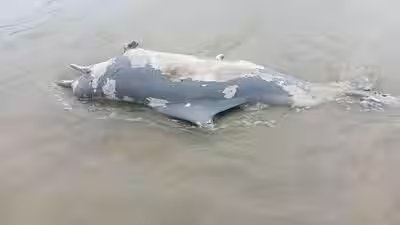
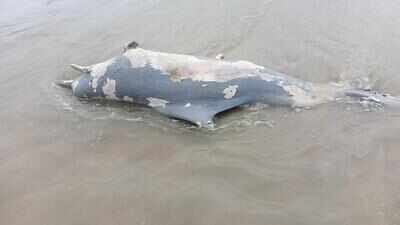
Panaji: Last Thursday, those manning Goa’s beaches were in for a shock. Three Indian Ocean humpback dolphin calves were found washed ashore at different locations, including Cavelossim and Sinquerim, in a single day.Since July 1, this year, 15 dolphins have washed ashore across the state’s shoreline, sources said. They are less of strandings and mostly carcasses already in varied stages of decomposition, which means the rescue opportunity is already lost.This monsoon is not an anomaly. Report compiled under the Goa Marine Megafauna Stranding Project, which began in 2021 to document strandings and standardise response, shows that between 2021 and 2025, a total of 1,683 strandings were recorded along Goa’s coast.But conservation efforts have largely centered solely around sea turtles and little shock is seen on strandings of dolphins and porpoises which are not migratory but residents of Goan waters.As per the stranding report, though Sea turtles accounted for the largest share, with 852 strandings. Cetaceans — including dolphins and porpoises — made up 461 strandings, while 375 seabird strandings were also documented. The report was compiled by ReefWatch Marine Conservation, which provides veterinary support to the stranding response effort.The report shows that multiple stressors are leading to the increases Cetacean deaths including climate change, pollution, fishing nets.Goa, however, is yet to have a mega fauna rescue SoP in place.Over the past two months, staff manning Goa’s marine ranges have reported an increase in porpoise carcasses washing ashore. Carcasses have been found at Baina, Colva, Velsao, Arossim, Cavelossim, Majorda, Agonda, and Baga.Conservationists note that Goa has operated a sea turtle conservation programme for decades, but argue that attention must now expand to other marine mammals — particularly as the state promotes dolphin-watching as a tourism activity.Stranding counts peaked during the monsoon and summer, mirroring broader stranding patterns and indicating the influence of seasonal processes.“Species-level analyses indicate that Indian Ocean humpback dolphins and Indo-Pacific finless porpoises account for the majority of deaths and display the widest range of causes, while larger or offshore species contribute only isolated cases,” the report states.The Goa Marine Megafauna Stranding Project was created after beginning as a programme for lifeguards and forest guards, developed through a collaboration involving IUCN India (under the Mangroves for the Future regional initiative), Terra Conscious, the Goa forest department, and Drishti Marine.“If we collate the number of dolphins and porpoises as well as strandings of other species reported along Goa’s shores from 2017 to 2025, it is quite high for a small coastline,” said Puja Mitra, founder of Terra Conscious.“With dolphin-watching dependent on residential, near-shore species like the Indian Ocean humpback dolphin, and being actively promoted by govt, we need to improve the focus on marine mammal conservation and enable the industry to transition towards responsible wildlife watching practices, sensitise consumers to be conscious visitors supporting conservation, and enable better livelihoods for local communities that champion Goa’s marine biodiversity responsibly,” she said.