








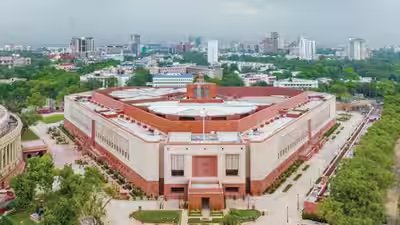
NEW DELHI: India’s existing 543 Lok Sabha constituencies currently show considerable disparities in terms of area, number of registered voters and population density, with some constituencies covering enormous geographical territories but having relatively few voters, while others are geographically small but have millions of voters.Data reflecting the disparities have significant implications for parliamentary representation and the workload for elected representatives, making a strong case for a fresh delimitation exercise.For example, the MP from Ladakh, the biggest constituency in terms of area (1,72,374 sq km), faces enormous logistical challenges in navigating through it and reaching voters, whereas a parliamentarian from a densely populated urban constituency such as South Mumbai, Kolkata Uttar, Chennai Central or Chandni Chowk faces a different challenge while trying to meet the expectations and demands of millions of people.
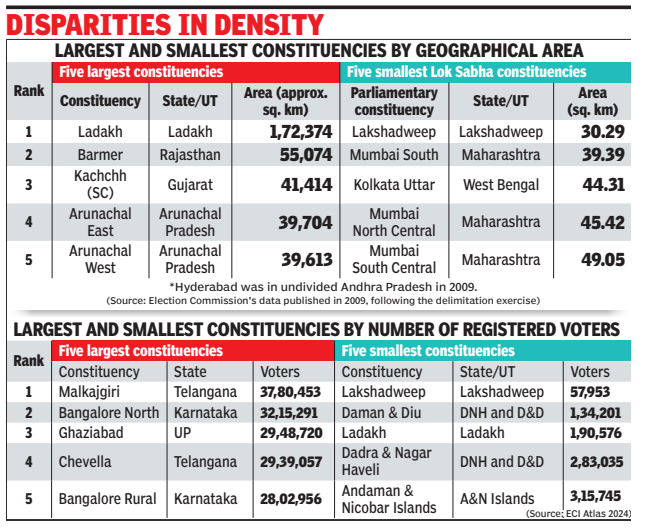
Population density represents an important dimension of the disparities. It means equal representation cannot be measured by population alone without considering geography and accessibility.An MP can represent vastly different numbers of people. A parliamentarian from Malkajgiri in Telangana represents an electorate of nearly 37.8 lakh, whereas an MP from Lakshadweep represents fewer than 58,000. This raises a valid question about equality of representation.
Share your thoughts in the comments
Be respectful · TOI community guidelines
The last delimitation exercise in the country was conducted from 2002 to 2008 by Delimitation Commission of India, constituted in 2002, but it did not change the allocation of Lok Sabha seats among states as the 42nd Constitutional Amendment had frozen this based on the 1971 Census. This was done to avoid penalising states that had successfully controlled population growth.In 2001, the 84th Constitutional Amendment extended the freeze until the first census conducted after 2026.Currently, inter-state representation disparities are a stark reality. Data shows that an MP represents a population of 26 lakh in Bihar and 25 lakh in UP, whereas this number is 18.5 lakh in Tamil Nadu and 16.7 lakh in Kerala.