










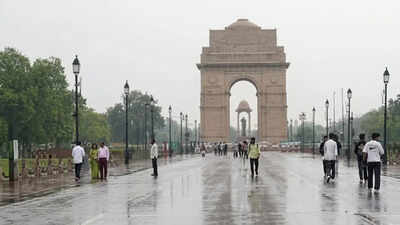
NEW DELHI: Delhi is witnessing a change in weather conditions as light rain has begun over parts of the city, marking an early onset of the predicted thunderstorm activity along with lightning and gusty winds. The Regional Weather Forecast Centre, Delhi, on Wednesday had forecast thunderstorm accompanied by lightning and strong winds gusting up to 50 kmph for the capital, with maximum temperatures expected to remain between 37 and 39 degrees Celsius. According to the IMD’s Daily Weather Report and Forecast Bulletin issued on Tuesday evening, maximum temperatures in Delhi are set to rise gradually by 3 to 5 degrees Celsius over the next seven days, while no significant change is expected in minimum temperatures over the next four days. On Tuesday, Safdarjung, the city’s base station, recorded a maximum temperature of 39.0°C, which was 0.5 degrees below normal, while the minimum stood at 27.6°C, 2.2 degrees above normal. Humidity levels fluctuated between 39% and 68% during the day, with easterly winds blowing at around 15 kmph. Across the Delhi-NCR region, daytime temperatures ranged from 35.2°C in Mayur Vihar to 39.0°C at Safdarjung, while minimum temperatures varied between 25.5°C in Palam and 29°C in Noida. For Wednesday, May 13, the IMD had forecast partly cloudy skies with a possibility of very light rain, along with thunderstorms, lightning and gusty winds reaching up to 50 kmph during the forenoon hours. Maximum temperatures were expected to stay between 37 and 39 degrees Celsius, while minimum temperatures may settle between 26 and 28 degrees. From May 14 onwards, weather conditions are likely to gradually improve, with mainly clear skies expected from May 15 to May 18. However, temperatures are set to climb, with maximums likely reaching 40 to 42 degrees Celsius by May 17 and 18, while minimums may rise to 27 to 29 degrees. The IMD has also indicated that a fresh Western Disturbance is likely to affect Northwest India from May 15. Three upper air cyclonic circulations are currently active — over North Pakistan, West Rajasthan, and North-Central Uttar Pradesh — continuing to influence weather patterns across the region.