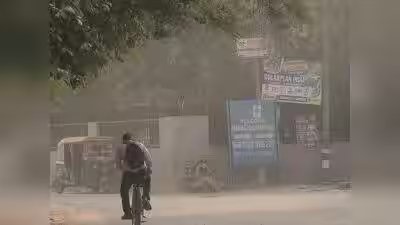








JHAJJAR: Air quality across Delhi-NCR and several parts of Haryana deteriorated sharply on Monday morning following widespread firecracker bursting on Diwali night. Bahadurgarh in Jhajjar district recorded an Air Quality Index (AQI) of 392, while Rohtak ranked second with an AQI of 383, placing both cities in the ‘very poor’ category.Reduced visibility was also reported in several areas during the morning hours, as smoke and pollutants from firecrackers added to the existing pollution burden.Among other Haryana cities, Charkhi Dadri recorded an AQI of 371, Bhiwani 369, Sirsa 362 and Panchgaon 359. Kaithal and Faridabad recorded 338 each, followed by Ballabhgarh at 334 and Jind at 310. Delhi recorded an AQI of 370, while Khoda in Uttar Pradesh reported 400.A total of 23 cities recorded AQI levels of 300 or above. According to the standard AQI classification, readings between 301 and 400 fall in the ‘very poor’ category, while levels above 400 are classified as ‘severe’.Rohtak deputy commissioner Satvir Singh said the municipal corporation had deployed eight anti-smog machines across the city to control dust and pollution. He said stubble-burning incidents had remained relatively low in the district this year, although cases had been registered against two farmers for allegedly burning crop residue.“The administration is taking strict measures to prevent stubble burning. Action will be taken against anyone found violating the directions,” he said.However, open waste burning has emerged as another concern in Rohtak. Garbage was seen burning at several locations in the city on Sunday and Monday mornings. Stubble burning was also reported in one or two villages of the district.Smoke released from burning garbage adds to the pollution load, raising concerns over the effectiveness of enforcement measures on the ground.Repeated attempts to contact Rohtak’s regional pollution control officer, Dinesh Kumar, for his response remained unsuccessful. He did not answer calls or respond to WhatsApp messages.No stubble-burning cases reported in Jhajjar: DCJhajjar deputy commissioner Varsha Khangwal said no stubble-burning incident had been reported in the district so far this season.She attributed the rise in pollution partly to atmospheric conditions and changes in wind movement. Anti-smog machines have been deployed, while special teams have been constituted to monitor violations and ensure compliance with pollution-control directions.She said the administration had issued strict instructions against stubble burning and would intensify monitoring and enforcement.Dr H. K Aggarwal, vice-chancellor of the health university in Rohtak, warned that the deteriorating air quality could pose serious health risks, particularly to vulnerable patients.“People suffering from respiratory and heart diseases, allergies, cancer and tuberculosis are particularly vulnerable to high levels of air pollution,” he said.Health experts caution that prolonged exposure to polluted air can aggravate existing medical conditions and trigger breathing difficulties. Children, elderly people and those with pre-existing illnesses are also at greater risk.With pollution levels rising across Delhi-NCR, restrictions under Stage III of the Graded Response Action Plan (GRAP) have been imposed. Authorities are facing the challenge of controlling multiple sources of pollution, including firecrackers, stubble burning, open waste burning, vehicular emissions and construction-related dust.The post-Diwali pollution spike has once again highlighted the need for coordinated action across NCR, with effective monitoring of pollution sources beyond just firecrackers and agricultural residue burning.