








For Uttar Pradesh, the ambition of becoming a trillion-dollar economy is not merely a question of achieving a larger Gross State Domestic Product. It is also a question of geography. Since March 2017, the Yogi Adityanath government has increasingly sought to answer these questions by reshaping the state’s economic geography. The strategy is gradually moving Uttar Pradesh away from a model in which investment, industry and high-value employment are concentrated in a few established urban centers towards a more decentralised and polycentric economy in which districts, smaller cities and emerging industrial corridors become growth engines in their own right.The transformation is taking place against the backdrop of a substantial expansion in the state economy. The first-ever Economic Survey of Uttar Pradesh in 2025 revealed key facts and figures supporting this direction. Uttar Pradesh’s GSDP rose from around Rs 13.30 lakh crore in 2016–17 to approximately Rs 30.25 lakh crore in 2024–25, with the state projecting further expansion to around Rs 36 lakh crore in 2025–26. Its economy has recorded a compound annual growth rate of about 10.8 per cent during the period covered by the state’s recent economic assessment. Per capita income has also risen significantly, reflecting the broadening scale of economic activity.But aggregate growth tells only part of the story. For a state as geographically, economically and demographically diverse as Uttar Pradesh, the real test is whether the next phase of expansion can create viable centres of production, employment and enterprise beyond the traditional industrial belt. That is where the government’s decentralisation strategy assumes significance.
ODOP: Giving districts an economic identity
Perhaps no programme illustrates this approach more clearly than the One District One Product (ODOP) initiative.For decades, many of Uttar Pradesh’s traditional products were known nationally but remained trapped in fragmented production systems, with artisans receiving only a small share of the final value. ODOP sought to change that equation by giving each district a recognisable economic identity and connecting its traditional strengths with modern markets.Varanasi’s silk and textiles, Bhadohi’s carpets, Moradabad’s brassware, Saharanpur’s wood products, Aligarh’s locks, Meerut’s sports goods and Lucknow’s chikankari and zardozi are no longer being viewed simply as traditional occupations. They are increasingly being positioned as district-level economic assets.The importance of ODOP lies in the ecosystem that has developed around these products. Branding, design development, skill training, modern tools, credit facilitation, packaging, exhibitions, e-commerce and market linkages can help transform a household craft into a commercially sustainable enterprise.The larger objective is economic localisation. If production, processing, design, marketing and ancillary activities can be developed around a district’s principal product, a larger portion of the value chain remains within that district.This has important implications for employment. Instead of compelling skilled workers to migrate to large cities, local economic ecosystems can create opportunities closer to their homes. The artisan can become an entrepreneur; a family workshop can evolve into an MSME; and an established cluster can generate employment for workers beyond the traditional producer community.ODOP, therefore, is not merely a handicrafts programme. Properly integrated with credit, infrastructure, exports and digital commerce, it becomes an instrument of decentralised industrialisation.
Expressways are changing the investment map
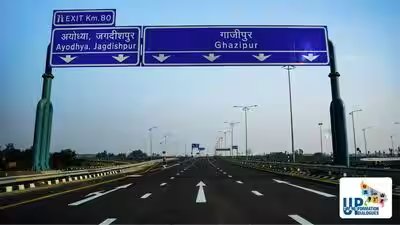
The second major pillar of decentralisation is infrastructure. Uttar Pradesh’s expanding network of expressways has begun to change the economic logic of location. Connectivity is no longer confined to the established industrial centres of western Uttar Pradesh. Regions such as Purvanchal and Bundelkhand are increasingly being connected to major consumption centres, ports, airports and other parts of the country through high-speed road corridors.The economic significance of an expressway extends well beyond reducing travel time. It creates a platform for logistics parks, warehouses, industrial estates, food-processing units, manufacturing clusters and service businesses.For a manufacturer, reliable connectivity reduces logistics costs. For an agricultural producer, it can improve access to distant markets. For a logistics operator, it creates a reason to establish a distribution centre. For an investor, it makes previously peripheral locations more commercially viable. This is particularly important for Bundelkhand and eastern Uttar Pradesh, where distance and inadequate connectivity had historically constrained industrial development.The emerging model is therefore one of ‘expressway-led economic development’, in which physical infrastructure becomes the backbone for a wider industrial and urban ecosystem. The objective is not necessarily to reproduce Noida in every district. It is to enable different regions to develop according to their comparative advantages.
Incentives designed to redirect investment
Infrastructure alone, however, cannot decentralise investment. Investors also respond to costs, incentives, availability of land, skilled labour and the ease of doing business. The state’s Industrial Investment and Employment Promotion Policy therefore attempts to use differentiated incentives to make less-developed regions more attractive.The policy framework provides stronger incentives for investment in Bundelkhand and Poorvanchal than in already developed industrial locations. Stamp-duty exemptions, for example, can reach 100 per cent in these less-developed regions, compared with lower levels in more developed areas such as the Gautam Buddha Nagar-Ghaziabad belt.This differentiation is significant because a uniform incentive structure can inadvertently reinforce existing concentrations. A new investor naturally prefers locations where infrastructure, suppliers, skilled labour and markets already exist. Without additional incentives, capital tends to follow capital.Differential incentives seek to break that cycle. The state’s investment drive has also generated proposals worth around ₹50 lakh crore since 2017, creating a potentially large pipeline of projects. The challenge now is to ensure that this investment is not disproportionately concentrated in the already prosperous western corridor, but is translated into productive capacity across regions.The success of decentralisation will ultimately depend less on the headline value of investment proposals and more on their actual implementation, employment generation and geographical distribution.
From district products to global markets
The next logical step in decentralisation is export expansion.Uttar Pradesh has a substantial manufacturing and handicraft base, but many district-level producers historically depended on intermediaries to access national and international markets. This limited their margins and often prevented smaller enterprises from developing direct relationships with global buyers.The Export Promotion Policy 2025–30 seeks to address this structural gap. It sets an ambitious objective of increasing exports from about US$21 billion in FY2024 to US$50 billion by 2030 while expanding the registered exporter base.More importantly, the policy seeks to bring districts into the export ecosystem, with particular attention to MSMEs, startups, ODOP enterprises and first-time exporters. This could become one of the most powerful mechanisms for decentralised growth.Consider the potential chain reaction. A Bhadohi carpet exporter needs yarn suppliers, dyers, designers, packaging firms, transporters and financial services. A Saharanpur wood-product exporter needs skilled craftsmen, timber-related supply chains, finishing units, packaging and logistics. An agro-processing exporter in eastern Uttar Pradesh needs farmers, collection centres, cold chains, processing facilities, quality testing and warehousing.Once exports begin to grow, the economic impact therefore extends far beyond the exporting company. The development of district-level export promotion councils, trade facilitation centres, testing laboratories, warehousing and logistics infrastructure can reduce the dependence of smaller producers on metropolitan intermediaries. International demand can consequently become a mechanism for distributing income across districts.The ambition is to make “Made in Uttar Pradesh” a much broader proposition—not one associated primarily with a few established industrial centres, but with hundreds of products and enterprises spread across the state.
The 100-township strategy
The announcement in February 2026 of plans for 100 new townships over five years represents another important dimension of the decentralisation strategy. Urbanisation is inevitable in a rapidly growing economy. The question is whether it will be planned or unplanned.Historically, Uttar Pradesh’s largest cities have absorbed enormous population pressures, resulting in congestion, rising land prices and increasing pressure on transport, housing, water and other infrastructure. If economic opportunities remain concentrated in a few metropolitan centres, migration into these cities will continue.The township strategy offers an opportunity to create alternative urban growth poles. Under the UP Township Policy 2023, the emphasis is on integrated urban development rather than simply creating residential colonies. New townships are expected to incorporate roads, drainage, water supply, electricity, green spaces, healthcare, education, commercial areas and other social infrastructure.Their economic role is equally important. A township near an industrial park can accommodate workers, professionals and service providers. An agricultural-region township can become a base for food processing, warehousing and agri-logistics. A location close to an expressway can develop around logistics, manufacturing and education. A tourism-oriented township can support hotels, restaurants, handicrafts and related services.In this sense, the 100-township programme can become an urban counterpart to ODOP: while ODOP seeks to build economic strength around the distinctive assets of districts, planned townships can provide the urban infrastructure required to sustain that growth.The long-term objective should be to create multiple centres of opportunity, rather than one dominant metropolitan core.
A polycentric Uttar Pradesh
The emerging economic geography of the state is increasingly regional in character. Bundelkhand has the potential to develop around defence manufacturing, renewable energy, logistics, minerals and large-scale industry. The region’s emerging infrastructure can help overcome its historic disadvantage of remoteness.Purvanchal can build on agriculture, food processing, textiles, pharmaceuticals, tourism and services. Cities such as Gorakhpur and Varanasi can function as regional anchors, linking surrounding districts to larger markets.Central Uttar Pradesh, with Lucknow as a major administrative and services centre, has the potential to deepen its manufacturing, logistics, IT and knowledge-based economy. Lucknow’s emergence as a technology and services hub can have spillover effects on surrounding districts if transport and digital connectivity are strengthened.Western Uttar Pradesh will continue to remain the state’s most industrialised region, benefiting from its proximity to Delhi-NCR, strong manufacturing networks, agriculture and exports. The objective is not to slow this region down, but to enable other regions to catch up faster.That distinction is important. Decentralisation does not mean redistributing existing economic activity mechanically. It means creating additional engines of growth.
Smaller cities as the next frontier
The future of Uttar Pradesh’s economy may increasingly depend on its second tier of cities. Varanasi, Prayagraj, Gorakhpur, Bareilly, Moradabad, Agra, Kanpur, Jhansi and several other urban centres can serve as regional economic anchors. Their development can reduce the pressure on Lucknow and the NCR while providing surrounding districts with access to higher-quality services.Reliable electricity, modern roads, digital connectivity, educational institutions, healthcare, affordable commercial space and financial services can transform these cities into magnets for investment and skilled workers. The same principle applies at the district level. If a young entrepreneur can establish an enterprise in a district headquarters rather than moving to Delhi, Mumbai or Bengaluru, the economic value generated by that enterprise remains more closely connected to the local economy. This is where decentralisation intersects with social development.In fact, the local employment can reduce distress migration. Women can find greater opportunities to participate in the formal economy. Young people can establish businesses closer to their families. Farmers can move up the value chain through processing and branding. Traditional artisans can become market-oriented entrepreneurs. The economic and social benefits therefore reinforce each other.
The trillion-dollar test
Ultimately, the success of Uttar Pradesh’s decentralised-growth strategy will not be measured by the number of policies announced or projects sanctioned. It will be measured by outcomes.Is Gross District Domestic Product rising across a larger number of districts? Are formal jobs increasing? Are MSMEs surviving and scaling? Are exports coming from new districts? Is female workforce participation improving? Are young people finding meaningful employment closer to home? Are smaller cities attracting investment rather than merely sending workers to larger cities? These indicators will reveal whether growth is genuinely becoming more geographically distributed.The road to a trillion-dollar economy is therefore more than an exercise in multiplying the state’s aggregate output. It requires a transformation in the way Uttar Pradesh thinks about economic geography. For decades, the state’s enormous population was often described as a challenge. The emerging policy approach seeks to convert that scale into an economic advantage by creating multiple centres of production, consumption, innovation and employment.ODOP gives districts an economic identity. Expressways connect them to markets. Industrial incentives make new locations more competitive. Export policies connect local enterprises to global demand. New townships can create the urban infrastructure needed to support expanding economies. Together, these initiatives point towards a model in which growth is not confined to a few established corridors.Nine years into the Yogi government’s tenure, Uttar Pradesh has built a substantial foundation for this transition. The next phase will be harder: translating infrastructure and policy into durable private investment, productive employment and rising household incomes across the state.If that happens, the significance of the transformation will extend well beyond the achievement of a trillion-dollar economy. It will mean that Uttar Pradesh is no longer defined economically by a handful of prosperous regions, but by a network of interconnected growth centres stretching from Bundelkhand to Purvanchal and from the western industrial belt to the heart of central Uttar Pradesh.