









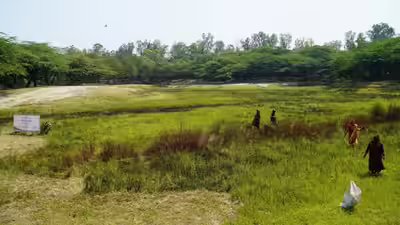
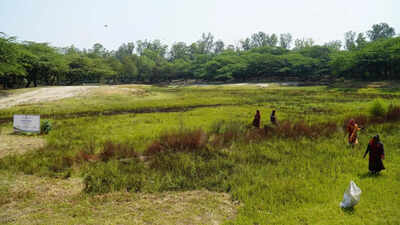
New Delhi: An almost dried-up waterbody inside the district park in Paschim Vihar witnessed unusual activity on Saturday as workers were busy clearing thick vegetation and removing accumulated soil before preparing channels to bring rainwater from nearby catchment areas during the monsoon.The restoration work marked the launch of Delhi Development Authority’s (DDA) Jal Sanchay Abhiyaan, under which 101 waterbodies across the city will initially be rejuvenated as part of a larger plan to revive Delhi’s traditional water systems and improve groundwater recharge.Launching the campaign, lieutenant governor Taranjit Singh Sandhu said the initiative was aimed at strengthening Delhi’s long-term water security and ecological resilience rather than serving as a mere beautification exercise.Officials said the initial plan was to rejuvenate 77 waterbodies in phase I, but the number increased after LG recently reviewed the proposal and directed authorities to expand the scope of the campaign.Most of the identified waterbodies are either severely degraded, encroached upon or completely dried up, officials said, adding that many are struggling for survival due to years of neglect, urbanisation and discharge of untreated waste.“The initiative, which began with the restoration of a 1.47-hectare waterbody inside district park, Paschim Vihar, is part of a larger effort to improve groundwater recharge, rainwater harvesting and ecological sustainability in the city,” Sandhu said.The first phase will cover 101 waterbodies spread across nearly 383 acres, with restoration works targeted for completion by Aug 30. They include 22 waterbodies in Dwarka, 17 in Rohini, 13 in south Delhi and six in Narela. The locations include Bhalswa behind Sanjay Enclave, district park sector 20 Rohini, Tihar Lake, Astha Kunj in Kalkaji, Kalindi Aviral waterbody nos. 2, 3 and 4, Maidan Garhi, Jharoda Kalan in Dwarka, Smriti Van in Narela, Hiranki, Kapashera, Mahipalpur, Rajpur Khurd, Bakkarwala, Baprola, Tikri Kalan and Hasanpur.Addressing the gathering, Sandhu stressed the need to revive Delhi’s traditional network of baolis, lakes and reservoirs that once played a crucial role in flood management and maintaining ecological balance in the city.DDA manages 822 waterbodies, of which 424 will eventually be restored and conserved. Officials said Delhi historically had an extensive network of baolis, lakes, reservoirs and natural streams, but rapid urbanisation and encroachments had severely damaged many of them over the years.In phase I, restoration measures such as dredging, excavation, desilting and clearing of natural catchment channels will be undertaken to improve rainwater harvesting capacity ahead of the monsoon.The second phase, targeted for completion by May 2027, will focus on long-term sustainability measures, including fencing, strengthening embankments, plantation drives and installation of sewage treatment plants wherever feasible.