










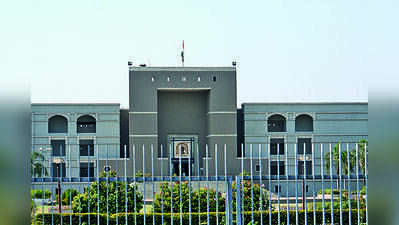
Ahmedabad: Gujarat High Court has ruled that crossing railway tracks cannot automatically be treated as a criminal act, particularly at busy stations and yards where foot overbridges may be distant, inaccessible or overcrowded. It directed the Railways to pay Rs 8 lakh in compensation to the family of a passenger who died after being run over by a train.Nineteen-year-old Mahendrakumar Nanhkaunu was travelling from Kanpur to Ahmedabad aboard the Howrah-Gandhidham Express in July 2023 when he fell from an overcrowded general compartment following a sudden jerk, between Vadodara and Ahmedabad stations. He was dragged after falling. As he tried to move away from the tracks, another train approaching on the second track ran over him. His family sought compensation, maintaining that Nanhkaunu was a bona fide passenger holding a valid ticket.Railway Claims Tribunal, however, rejected the claim, accepting Railways’ argument that Nanhkaunu had attempted to get off the train unauthorisedly at a location without a scheduled halt or platform. It also held that he was illegally crossing the tracks when the accident occurred.The family challenged the tribunal’s order in Gujarat HC through advocate Rathin Raval. He argued that the incident involved neither trespass nor criminal negligence by the passenger and squarely qualified as an ‘untoward incident’ under Section 123(c)(2) of the Railways Act, 1989.Justice D A Joshi, after hearing the matter, said the tribunal had adopted a hyper-technical approach that ran contrary to the welfare-oriented objective of the Railways Act.High court observed that the claim had been rejected because a valid ticket did not authorise a passenger to cross or trespass onto railway tracks, effectively attributing the fatal accident to be fault of the victim. Rejecting this reasoning, it said: “This approach is fundamentally flawed and contrary to the settled principles of law governing railway compensation. In busy railway stations and yards, particularly where foot over bridges are either inaccessible, distant, or overcrowded, passengers frequently cross tracks to reach platforms or exit the premises. While such an act may constitute negligence or carelessness on the part of the passenger, it cannot be equated with a “criminal act” or “self-inflicted injury” so as to absolve the railway administration of its statutory liability,” the HC order read.