








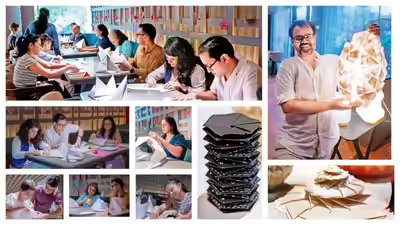
Modular origami has emerged as one of Mumbai’s popular creative trends, with workshops, hobby groups and home décor enthusiasts embracing the intricate Japanese paper-folding art. ‘ORIGAMI IS AN EXTREMELY MEDITATIVE PROCESS’ What’s drawing people to these workshops isn’t just artistic, it’s something more personal. For many, origami is a return to a childhood joy that adult life quietly crowded out. Mrunmaye Math, an orthodontist, knows this feeling well. “I used to dabble in origami as a child and when a friend suggested a weekend workshop, it was like going back to trying my hand at origami,” she says. Having explored crochet and knitting over the years, Mrunmaye considers origami her first creative love, one introduced to her by her parents. For her, the appeal is almost philosophical, “I feel origami is an extremely meditative process, folding paper and giving it form and shape, taking a flat piece of paper and transforming it into a three-dimensional object.” Jayshree Savani, a professional abstract artist, echoes that sentiment. “I have grown up loving origami and wanted to get back to it. I love the organic forms that can be made, and love this transformative process,” she says, adding that even a punishing Mumbai heat wave wasn’t enough to keep her away from the workshop. ‘MODULAR ORIGAMI HAS A LOT OF SCIENCE BEHIND IT’ For Foram Khanderia, an engineer, a trip to Japan a few years ago reignited a childhood fascination. “All rooms there would have small origami and I loved it, and that is what led to attending this workshop,” she explains. “As an engineer, I am finding this modular origami way beyond the folded animals and birds I had seen in my childhood. This one has a lot of science behind it.” Foram’s observation points to something important: modular origami, which involves interlocking multiple folded units into complex geometric structures, has introduced a more intellectually rigorous dimension to the craft, one that appeals strongly to analytical minds. ‘MUMBAIKARS ARE EMBRACING INTERACTIVE EXPERIENCES LIKE ORIGAMI’ “The response to my instagram reel has been overwhelming, especially for the origami lamp workshop,” says Tejas Uzgare, who has been conducting origami workshops across Mumbai for the past couple of years. “I feel that Mumbaikars are really embracing interactive experiences across the board. Origami is a relatively rare one. I think people enjoy this as it lets them take the ubiquitous sheet of paper and transform it into an object of beauty and purpose, both at the same time.” Beyond the craft itself, Uzgare has observed something deeper unfolding in his sessions — a genuine human connection that is increasingly hard to find in a city that never stops moving. “The social aspect also fascinates me. It’s something you can’t put into words, to gather with strangers and bond over learning and discovery. There’s a sense of community for those three hours. And you make new friends too.” ‘I WAS INTRIGUED BY THE REEL BUT ACTUALLY IT IS QUITE COMPLEX!’ Not everyone arrives with a nostalgic pull. Some are drawn in by curiosity, or a scroll through social media. Nikita Vaswani, an entrepreneur from Worli, stumbled upon the workshop through an Instagram reel. “I was intrigued when I saw the reel and it seemed easy,” she admits with a laugh. “But now I have realised that it is quite complex. But thanks to the instructor, I have been able to complete the project.” It’s a sentiment shared by many first-timers who quickly discover that beneath origami’s serene surface lies a world of geometry, precision, and patience. MAKING IT PERSONAL, MAKING IT FOR HOME Perhaps the most telling sign of origami’s growing cultural relevance in Mumbai is the desire to bring it home – literally. Ruchir Arora, a project manager from Powai, wanted a handmade origami lamp for his living room and that is what led him to attend a workshop on this in South Mumbai. “I have not been into origami as such, never learnt it, but am aware of the concept. Currently I’m setting up my living room and this idea of an origami lamp looked very interesting,” he says. “This one would be something personal, handmade, something I wanted to use in my home décor.” Twelve-year-old Adam Kagalwala represents the next generation of folders. An origami enthusiast for the past couple of years, Adam has long filled the house with paper crafts. His mother, Tasneem sees this interest as a meaningful step forward. “At home, when he used to make these, we didn’t know what to do with all those paper crafts,” she says warmly. “But now he has taken his passion one step further and are shaping paper into an actual product, which is so interesting.” ‘I HAVE OVERCOME MY ART-BLOCK AND LOVED FOLDING AGAIN’ Despite the growing enthusiasm, seasoned practitioners are careful to keep perspective. Smruthi Gadre, a science and math teacher from Goregaon who has been folding for six years and participated in origami exhibitions, sees immense potential, alongside honest limitations. “Compared to Japan or other countries, India still has a long way to go when it comes to origami, but the interest here is really great,” she says. For Gadre, who attended an origami workshop in Worli, after a two-month creative block, the session held deep personal significance. “I have now overcome my art-block.” She is also a firm believer in the discipline the craft demands. “Every single crease is important. If your creases are sharp and correct, then your end product will look great.” in:sent origami. Press Tab to insert.