








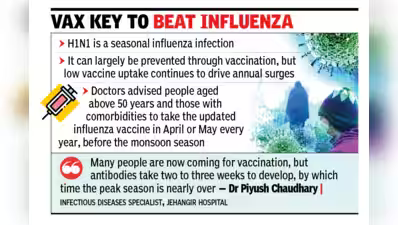
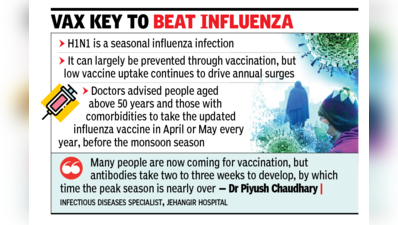
Pune: Covid-19 infections — largely mild initially — are increasingly triggering moderate to moderately severe illness, while H1N1 influenza has emerged as the more serious respiratory infection this season.Doctors reported an increase in ICU admissions, ventilator support and flu-related acute respiratory distress syndrome (ARDS) because of H1N1 influenza. They warned that complacency towards annual influenza vaccination after the Covid pandemic might be contributing to the current surge. According to Maharashtra govt data, a total of 427 confirmed H1N1 (swine flu) cases and four deaths were reported in the state till July 31 this year.Dr Piyush Chaudhary, infectious diseases specialist at Jehangir Hospital, said unlike earlier in the season, when Covid infections were so mild that many questioned the need for testing, patients were now showing at least moderate severity. “But H1N1 is proving to be the more severe illness this monsoon, with cases more serious than those seen over the past two years,” Dr Chaudhary said.Influenza patients typically present with high-grade fever, severe body ache, headache, sore throat and cough, whereas Covid patients are more likely to have upper respiratory symptoms accompanied by comparatively milder fever but pronounced fatigue. “H1N1 is causing some people to land up in ICUs as cases are increasing,” Dr Chaudhary said.According to doctors, the recent increase in severe H1N1 cases is linked to a sharp rise in overall infections during weather conditions favourable for viral transmission. “As more people become infected, a larger number of elderly individuals and those with diabetes, obesity or other underlying illnesses develop severe disease, requiring hospitalisation. The resurgence can also partly be attributed to declining public interest in flu vaccination. During the Covid pandemic, awareness about respiratory infections and vaccination was high, but over the past few years many people have become casual about annual flu shots,” Dr Chaudhary said.The specialist said influenza tends to witness major surges every two to three years because immunity wanes, while the virus undergoes antigenic drift and shift, leading to fresh outbreaks. Pune has experienced this cyclical pattern since the 2009 H1N1 pandemic.Dr Ameet Dravid, infectious disease specialist at Noble and Poona Hospital, said Covid-19 had “definitely seen an uptick” this year and had now become endemic. “Population immunity is gradually falling. If we test more patients coming with upper respiratory tract infections, I am sure we will detect more Covid-19 cases,” he said.He cautioned that doctors were now getting occasional severe Covid cases. “We have had one or two severe Covid cases. These patients developed pneumonia and required oxygen support, but fortunately they recovered. These severe infections have mostly been in elderly patients above 55 or 60 years of age, where immunity declines the fastest,” Dr Dravid said.He said H1N1 was the bigger concern this season. “The main reason is poor influenza vaccination rates in India. Even elderly people and those with serious comorbidities often do not take their annual flu shots. Every couple of years, either H1N1 or H3N2 resurfaces. This year H1N1, or swine flu, has raised its head. Many patients are presenting with upper respiratory infections, while some develop lower respiratory tract infections and pneumonia. Some have required ventilator support and we have also seen one or two deaths. At present, H1N1 is causing the maximum damage, while Covid has quietly made a comeback,” he said.Dr Mahesh Kumar Manohar Lakhe, infectious diseases expert at Sahyadri Hospitals, said, “Every year we see a rise in H1N1 cases. The typical symptoms are sudden high fever, dry cough, sore throat and body ache. Most of the H1N1 patients we see are unvaccinated.”Dr Lakhe said most of the Covid-19 patients requiring hospital care were older adults.