








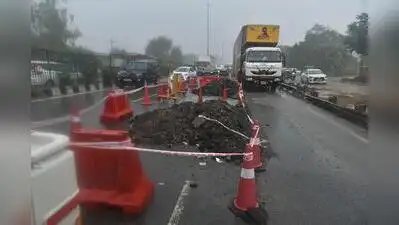
Gurgaon: Months before a portion of Delhi-Gurgaon Expressway caved in near Narsingpur on Tuesday evening, National Highways Authority of India (NHAI) had raised a series of concerns over the proposed stormwater drainage project beneath the highway, questioning its design, technical details and execution methodology.In Dec last year, NHAI’s consultant pointed out several deficiencies in the design, including inconsistencies in invert levels, missing road level details, undefined vertical clearances and incomplete structural specifications. The consultant also observed that the proposed drainage layout did not conform to the ministry of road transport and highways (MoRTH) specifications and Indian Roads Congress (IRC) guidelines.Citing chronic monsoon flooding on NH8, GMDA continued to pursue the project, arguing that a cross-drainage structure was essential to prevent recurring waterlogging. According to NHAI officials, the authority had reservations over the trenchless construction method (involving minimised digging) proposed by GMDA. An NHAI official told TOI, “Concerns were raised that the trenchless method was not the most viable option as there was no adequate cushioning. However, after GMDA assurance that all necessary precautions would be taken during the execution of the work, permission was granted.”On Tuesday evening, following heavy rainfall, the stretch where the culvert was being laid caved in, leaving a large crater on the Delhi-Jaipur carriageway. The incident forced authorities to close two lanes, leading to traffic jams stretching several kilometres during the evening peak hours. The cave-in has renewed scrutiny over the execution and monitoring of underground infrastructure works beneath high-speed highway corridors, particularly as the project underwent detailed examination before construction began.The NHAI consultant also questioned the feasibility of constructing a new crossing at the proposed location. Instead, it suggested connecting the proposed drain to NHAI’s existing Culvert-III near Badshapur, eliminating the need for constructing a fresh crossing beneath NH8.Based on these observations, NHAI rejected GMDA’s proposal in Jan and asked the metropolitan authority to submit revised drawings and fresh cost estimates. With NHAI’s reluctance to take up the work, GMDA renewed its request in April. In a letter to NHAI chairman Santosh Kumar Yadav, GMDA CEO PC Meena said the absence of a cross-drainage structure near Radha Krishna Garden became a major cause of waterlogging during every monsoon, as stormwater from adjoining areas had no outlet to cross NH-48.The authority then proposed laying pipes beneath the highway using trenchless technology or precast system. It also offered to execute the work on a deposit basis with GMDA funding while adhering to NHAI’s specifications. Following approval, work commenced last month. Two of the three 900 mm diameter pipelines were already pushed beneath the highway when the carriageway caved in on Tuesday.On Wednesday, the damaged portion was filled with concrete while the affected stretch remained barricaded. Vehicles were allowed to move through the remaining lanes under traffic regulation.Explaining the incident, another senior official of NHAI said, “The heavy rainfall caused rainwater to seep into the trench, resulting in erosion of the soil supporting the carriageway and leading to the cave-in. Restoration work has been completed on priority. Once the repaired section, including the concrete, attains the required strength, the carriageway will be reopened to traffic. Moreover, we will ask the GMDA to undertake the work only after taking prevailing weather conditions into account and ensuring all necessary weather-related precautions are in place to prevent similar incidents in the future.”GMDA officials maintained that the responsibility of constructing a cross-drainage structure beneath NH8 primarily rested with NHAI. According to officials, GMDA took up the project only after repeated requests for the work yielded little progress, as the authority wanted to provide a permanent solution to waterlogging that inconvenienced commuters for years.The incident also bears similarities to a road cavity found on the Dwarka Expressway in Nov last year at a site where GMDA was laying a water pipeline. The closure of two lanes on NH8 has also increased traffic pressure on alternate routes of the city.“The cave-in on Sohna Highway has not been fully restored even after nearly two months and now another cave-in has occurred at Narsingpur. Traffic is being diverted through Rajiv Chowk and Subhash Chowk, which has further worsened congestion on Sohna Highway, where one side is already partially blocked because of repair work,” said Mahesh Khatana, president of the RWA at MVN Athens.