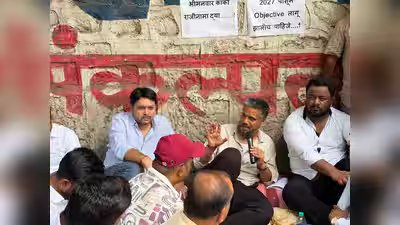









Pune: A newly announced common policy by the Maharashtra govt for five state-run educational institutes has drawn sharp criticism from several student organisations.These institutes are Chhatrapati Shahu Maharaj Research, Training and Human Development Institute (Sarthi), Dr. Babasaheb Ambedkar Research and Training Institute (Barti), Mahatma Jyotiba Phule Research & Training Institute (Mahajyoti), Tribal Research and Training Institute (TRTI), and Academy of Maharashtra Research, Upliftment and Training (Amrut).The major objections center on the decision to cap PhD research fellowships at 100 per institution, the failure to expand the number of beneficiaries for overseas scholarship schemes, and the lack of increased financial assistance despite rising education costs and inflation. Some critics also questioned the legality of a “common policy” for diverse social segments, arguing it contradicts the constitutional spirit of targeted support.“Since 2023, with the exception of TRTI, no organisation has published advertisements for PhD fellowships, meaning deserving students have been deprived of support. Our primary demand is that all organisations must advertise their fellowships annually,” said Rahul Sasane, president of the University Students’ Struggle Action Committee.Sasane further argued that Article 46 of the Constitution mandates the state to promote the educational interests of historically marginalised communities. “The population of every community is different. You cannot have blanket rules for open category students and SC category students alike. The policy should be about fostering equity among different communities, not imposing uniformity,” he added.According to students, previous govt resolutions (GRs) had promised 300 PhD scholarships for SC and ST students and 200 for other categories. However, because advertisements were never issued, these benefits remained on paper. The new GR, which introduces the 100-seat cap, was issued on July 1 by the state’s social justice and special assistance department.Kuldeep Ambekar, founder-president of Student Helping Hand and a beneficiary of the foreign scholarship programme, expressed disappointment over the lack of structural updates.“These organisations have been reduced to mere scholarship-disbursing bodies. We were hoping for a policy that introduced structural reforms, such as detailed regulations for each institution, grievance redressal cells, third-party social audits, regular governing board meetings, and strengthened institutional autonomy. Instead, there is nothing,” Ambekar said.Despite the criticism, Ambekar noted some positive aspects of the new policy, including provisions to coach 1,000 candidates for the Maharashtra Public Service Commission (MPSC) examinations and 400 for the Union Public Service Commission (UPSC) examinations, as well as allowing students to avail of benefits twice.