






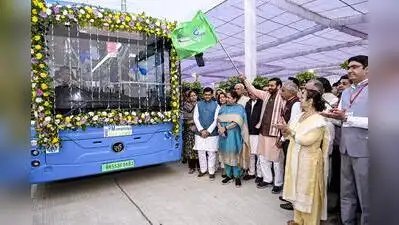
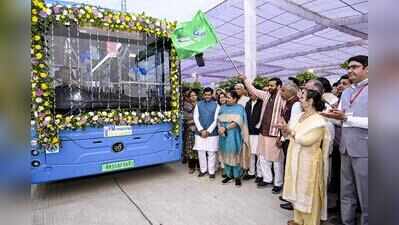
Gurgaon: Four years after its last fleet expansion, the city has received 100 new electric buses, taking the fleet strength of GMCBL to 250.Chief minister Nayab Singh Saini flagged off the buses on Saturday under the Centre’s PM-eBus Sewa scheme and inaugurated a new electric bus depot in Sector 48.The buses will operate on 20 routes connecting residential sectors, metro stations, railway stations, commercial hubs and villages, which is expected to improve connectivity across the city. The expansion, however, also brings into focus the considerable gap between Gurgaon’s growing transport needs and the number of buses available to serve commuters.Calling the launch an important milestone in the city’s public transport journey, Saini said the buses would give residents a more comfortable way to travel. “Electric buses are not just a new mode of transport. They will help reduce vehicular emissions as well as noise pollution. This will improve air quality and create a better environment for residents,” he said.The chief minister urged residents to prioritise public transport over private vehicles, saying fewer private vehicles on the roads would help ease congestion and pollution. He said the city’s growing economic importance, with national and international companies, IT establishments and service-sector institutions, had increased the need for safe and reliable public transport.City bus service began in Sept 2018 with an initial fleet of 25 buses, which was subsequently expanded to 150. The last addition came in July 2022, when air-conditioned buses were inducted as reserve. Since then, despite the city’s rapid expansion and the emergence of new residential and commercial hubs along Dwarka Expressway, Southern Peripheral Road (SPR) and Golf Course Extension Road, the fleet has remained largely unchanged.GMDA’s Comprehensive Mobility Management Plan projected a requirement of around 1,550 buses for the city by 2026. Even with the latest addition, the fleet of 250 buses remains significantly below that figure.Ministry of Housing and Urban Affairs (MoHUA) also assesses public transport availability against population under its Service Level Benchmarks for Urban Transport. For cities with a population of one to four million, its highest benchmark is 0.6 public transport units per 1,000 people. Even by that yardstick, the expansion does not keep pace with the city’s growth.The 20 routes include IMT Chowk to Dwarka Sector 21, Habitat Sector 99A to Guru Dronacharya Metro station, Millennium City Centre to Sector 37 Pace City, Dhana Mode to Gurgaon railway station, Mahavir Chowk to Ambience Mall, Dundahera to Sikanderpur Metro station and Gurgaon railway station to Sector 55-56 Metro station. Services will also connect the railway station with Kankrola-Bhangrola village, Mahavir Chowk with Wazirpur-T Point, and Millennium Metro station with Sector 107. Three to eight buses have been allocated to each route.Each bus is a nine-metre, air-conditioned, standard-floor vehicle with a seating capacity of 27, including the driver and conductor. The buses are equipped with CCTV cameras, panic buttons, fire alarms and emergency hammers, as well as hydraulic platforms for persons with disabilities, passenger information displays, public announcement systems and digital ticketing. With a battery capacity of 244 kWh, each bus can cover around 180 km on a full charge, and a complete recharge takes approximately two hours.The effectiveness of the new fleet, however, will depend on service frequency, the number of daily trips and last-mile connectivity. Jatin Punia, a commuter at Hero Honda Chowk, told TOI that reliability would be the key to getting more people onto buses.“I have used the new buses a couple of times and they are nice with less noise and travel is smooth. But timings are of concern. If I don’t know how much next bus will take then I simply choose shared autos,” he said.The Sector 48 depot, the state’s third electric bus depot, is spread over 7 acres and was developed by GMDA at a cost of Rs 17 crore. It can accommodate 120 electric buses, including space reserved for future expansion, and has 24 charging points with a 5 MVA power connection and a 120-metre-long covered charging shed. It also houses a 1,030 sqm maintenance workshop with three maintenance bays and four service pits, besides a 14-room administrative block, separate restrooms for male and female staff, a canteen and other facilities.The depot has a 12 KLD effluent treatment plant to recycle wastewater from bus washing, besides rainwater harvesting and a 16 kWp rooftop solar power system. CCTV surveillance and firefighting infrastructure have also been installed.Saini said the depot would provide the infrastructure required for efficient operation and maintenance of the electric bus fleet. He also directed officials to ensure that bus stops are clearly marked, with route information and timetables displayed, so that commuters can easily locate services and plan their journeys.He said Haryana is expanding electric bus services in other cities too. At present, 160 electric buses are operational in 10 major cities, and the number is targeted to rise to 375 by the end of this year. Under the PM-eBus Sewa scheme, 450 minibuses will also be introduced in Sonipat, Panipat, Rohtak, Karnal, Hisar, Gurgaon and Faridabad to improve last-mile connectivity.Industry and commerce minister Rao Narbir Singh, who attended the inaugural ceremony, said the city had needed electric bus services for a long time, adding that the buses would make commuting more convenient and help address pollution concerns.Later in the day, at a meeting with representatives of Raahgiri Foundation and Nagaro Foundation, Saini directed officials to develop modern roads in the city on the lines of Sanath Road, with dedicated and uninterrupted space for pedestrians and cyclists. He stressed uniform footpath designs, improved drainage and road planning that prioritises pedestrian safety alongside vehicular movement, and asked officials to incorporate the foundations’ suggestions into an integrated urban mobility plan.Saini also directed officials to identify street vending zones in all sectors to organise vendors and prevent encroachments on footpaths, roads and green belts. Land will be identified at four locations for vegetable markets, while officials have also been asked to find a suitable site for a museum to preserve Haryana’s cultural heritage. He further directed departments to lay utility ducts and pipes during CC road construction to avoid repeated excavation for water and sewer lines.