








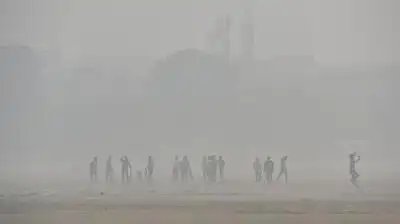
Gurgaon: Air quality deteriorated on Tuesday, with city’s average Air Quality Index (AQI) worsening from 247 on Monday to 290. While the city’s overall AQI remained in the ‘poor’ category, one of its four active monitoring stations recorded ‘very poor’ air quality. According to CPCB’s 8pm report, Sector 51 recorded the highest AQI at 320, followed by TERI Gram at 271. NISE Gwalpahari recorded an AQI of 262, while Vikas Sadan registered 266.The deterioration comes as meteorological conditions are expected to become less favourable for the dispersion of pollutants over the next few days. According to the Air Quality Early Warning System’s forecast for Delhi-NCR, the mixing depth is expected to be around 1,550 metres on Tuesday, compared with 2,000 metres on Monday. It is projected to decline further to 1,400 metres on Wednesday and 1,100 metres on Thursday.A lower mixing height restricts the vertical movement and dilution of pollutants, allowing them to remain concentrated closer to the ground.Wind conditions are also expected to influence pollution dispersion. The forecast indicates a shift from northwesterly winds on Tuesday to northerly and northeasterly winds over the next two days, with wind speeds of up to 10 kmph. The ventilation index is forecast to remain unfavourable for pollutant dispersion on Wednesday and Thursday.The Commission for Air Quality Management (CAQM) has revoked Stage III of the Graded Response Action Plan (GRAP) across Delhi-NCR following a downward trend in daily AQI, which reached 204 on Tuesday.The city’s AQI had improved to 247 on Monday from 296 on Nov 15, before deteriorating again on Tuesday. The November AQI calendar shows that pollution levels remained largely in the poor and very poor categories during the first half of the month. The highest reading was 368 on Nov 6, followed by 345 on Nov 7 and Nov 9.With mixing depth expected to decline and ventilation conditions remaining unfavourable, pollutants could take longer to disperse over the next two days.According to guidelines issued by the Central Pollution Control Board, when AQI is ‘poor’, respiratory illness can be felt by most people on prolonged exposure. An AQI between zero and 50 is considered ‘good’, 51 and 100 ‘satisfactory’, 101 and 200 ‘moderate’, 201 and 300 ‘poor’, 301 and 400 ‘very poor’, and 401 and 500 ‘severe’.Meanwhile in Delhi, construction activities will also remain banned till Jan 31 under the framework, and till Nov 20 in NCR under an earlier CAQM order.Delhi-NCR’s daily average air quality index (AQI) showed a downward trend, reaching 204 at 4pm, in the ‘poor’ category, before improving further to 198 by 6pm, in the ‘moderate’ category.However, as per IITM, the weather conditions may again turn against dispersion of pollutants, and AQI may touch ‘very poor’ levels — 301 to 400 on a scale of 0 to 500 — on Wednesday.GRAP-3 was imposed on Nov 6 after Delhi’s AQI climbed to 382 or the upper limit of ‘very poor’, with several areas recording severe pollution levels. Under GRAP-3, restrictions include a ban on major dust-generating construction and demolition activities, closure of stone crushers and mining operations, and restrictions on BS-3 petrol and BS-4 diesel four-wheelers in Delhi and five high-vehicle-density NCR districts. Provisions also allowed govts to consider hybrid classes for students up to Class V and 50% office attendance.Delhi’s winter pollution framework, which came into effect on Nov 1, continues to impose additional restrictions, including a ban on private construction till Jan 31 and restrictions on the entry of non-Delhi-registered BS-4 or older vehicles. The framework also provides for a blanket construction ban from Dec 10 to Jan 20.Meanwhile, favourable weather conditions and winds have contributed to the improvement in air quality. Restrictions under GRAP-1 and 2 will continue, along with the separate measures under Delhi govt’s framework.