






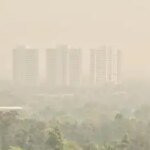



Chennai’s air quality this Diwali was its worst in the last three years, and noise levels recorded between 6pm and midnight on Sunday were the worst since 2017, data released by the Tamil Nadu Pollution Control Board (TNPCB) revealed. The data was collected from monitoring stations in seven residential and commercial locations.Valasaravakkam, which has been recording the worst Air Quality Index (AQI) since 2023, retained the record with a ‘very poor’ AQI of 343 and noise of 88.6 dB(A). Besant Nagar had the lowest AQI at 230, but its noise levels of 85.5 dB(A) were exponentially higher than the permissible limit of 40 dB(A) for a residential area.Worse, four of the seven regions — T Nagar, Nungambakkam, Valasaravakkam and Sowcarpet — recorded a ‘very poor’ AQI of more than 300. Last year, only Nungambakkam and Valasaravakkam recorded a ‘very poor’ AQI.While the average AQI stood at 281 — an increase from 259 in 2025 and 211 in 2024 — noise levels spiked to 83.8 dB(A). In 2024 and 2025, these levels were 62 and 70 dB(A), respectively.According to the Central Pollution Control Board (CPCB), an AQI between 200 and 300 is deemed poor, causing breathing discomfort even to healthy people. Noise exceeding permissible limits by more than 25 dB(A) can cause irritation to the eardrums upon prolonged exposure.Meanwhile, experts and environmentalists raised concerns over air quality monitoring in the city as several platforms relayed different AQI data to the public. Govt-run monitors cap the AQI at 500. Two of the nine govt-calibrated real-time AQI monitors of TNPCB and CPCB (in Ennore and Alandur) were not working, and the remaining showed AQI to be between 200 and 300. But independent monitors with unreliable calibrations, set up by private agencies, showed AQI to be more than 1,000 in several places.“Govt-run monitors are ideally the best bet, but the ones we have now are not adequate. They must be calibrated, and more areas must be monitored. The maximum cap on 500 must be removed,” said G Sundarrajan, environmentalist, Poovulagin Nanbargal.Environment minister V K Rajeev did not respond to texts and calls. A senior TNPCB official said the govt monitors were capped at 500 when they were set up around six years ago. “CPCB then thought an AQI of more than 500 would be rare in the city. The machines will have to be recalibrated. The NABL (National Accreditation Board for Testing and Calibration Laboratories) deals with the calibration process. We will also update the maintenance contract,” the official said.Meanwhile, engineers and environmentalists have ruled out an AQI of more than 1,000 in the city. “Since there was rain during cracker-bursting, the sensors would have picked up some ‘humidity’ components as pollutants,” said Shiv Nagendra, a professor at IIT Madras.