










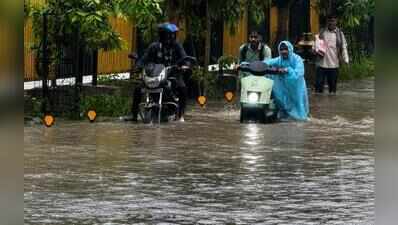
Gurgaon: Chaos descended upon the city yet again on Monday after an intense spell of rain left key stretches waterlogged, throwing traffic out of gear as commuters battled hours-long gridlocks across major corridors.The disruption was most visible at Subhash Chowk and Udyog Vihar, where water accumulated rapidly as the rain intensified. At Subhash Chowk, several school buses were stranded in deep water while commuters were forced to wade through flooded stretches. In Udyog Vihar, roads were inundated and visibility dropped sharply around noon, forcing two-wheeler riders to seek shelter under flyovers until the worst of the showers passed.Rajiv Chowk, Hero Honda Chowk, Golf Course Road, IFFCO Chowk, Old Delhi-Gurgaon Road, Sheetla Mata Temple Road, Sohna Road, Naharpur, Vatika Chowk and Narsingpur all witnessed heavy congestion.Delhi-Gurgaon Expressway was among the worst affected, while traffic on MG Road and connecting roads also slowed considerably. Several vehicles broke down after entering waterlogged stretches and had to be removed by police in coordination with civic authorities, further slowing movement.“I started from Udyog Vihar around 11.30am and reached Rajiv Chowk in around 90 minutes. There was major congestion even though I had avoided the peak hours. From Rajiv Chowk, it took another 30 minutes to reach the district court, a stretch that normally takes just five minutes. It was extremely frustrating to remain stuck in traffic for so long,” said Abhinav Shukla, an office-goer in Udyog Vihar.Golf Course Road-Hero Honda Chowk route was similarly affected. “It took me around two hours to cover the stretch. The journey was exhausting,” said Anuradha, a commuter.Traffic police deployed drones to monitor waterlogged areas and major roads, using aerial surveillance to assess conditions and identify locations needing immediate intervention. Traffic personnel were also deployed at waterlogged spots and major junctions to regulate movement and clear bottlenecks, but the simultaneous flooding of several arterial roads meant congestion persisted even as teams worked to restore movement.Gurgaon recorded 75mm of rain between 8am and 5pm, while Badshapur and Wazirabad recorded 65mm and 64mm, respectively. The rainfall was widespread across the district — Kadipur and Harsaru recorded 40mm each, Manesar 36mm, Sohna 16mm, Pataudi 12mm and Farrukhnagar 7mm over the same period.The rain came amid active thunderstorm development across Delhi-NCR. In a 10.02am update, weather observer Navdeep Dahiya said thunderstorm activity would remain active across the region for three to four hours, forecasting sudden moderate to heavy showers over Delhi, Gurgaon, Noida, Ghaziabad and Faridabad between 10am and 2pm, with rain at any given location lasting 45 to 60 minutes.Vishwas Chitale, fellow at Council on Energy, Environment and Water (CEEW), said Monday’s rainfall was part of a wider pattern of increasing monsoon variability. “The monsoon is not simply becoming wetter or drier, but increasingly erratic in its timing, distribution and intensity,” he said, citing CEEW’s long-term analysis showing that 64% of tehsils across India have seen more frequent heavy rainfall days over the last decade compared with the 1982-2011 baseline.Chitale added that 23% of districts, including New Delhi, have historically experienced a high frequency of both deficient and excessive rainfall years — and that in a highly urbanised region like Delhi-NCR, short bursts of intense rain can overwhelm drainage systems, disrupt mobility and essential services, and raise urban flood risk as concretisation reduces the land’s ability to absorb water. He called for climate-informed drainage infrastructure, restoration of urban water bodies and natural drainage channels, improved rainwater harvesting, and hyperlocal flood early-warning systems.