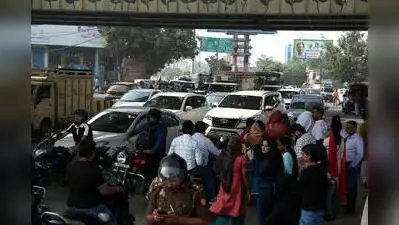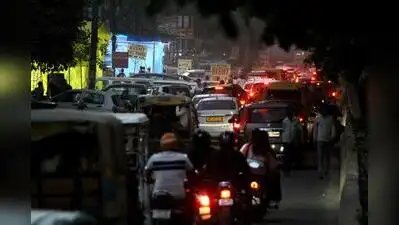







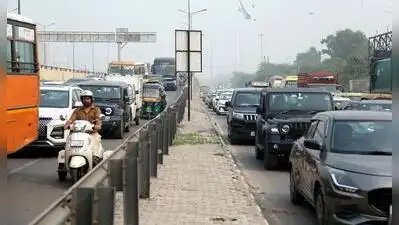
Ghaziabad/Noida: For the third consecutive day, commuters travelling from Ghaziabad to Delhi were caught in tailbacks as traffic crawled on Delhi-Meerut Expressway (DME) and NH-9 as police checked for emission compliance.On Wednesday, 196 vehicles were screened, and 33 turned back for failing to comply with the prescribed BS-VI emission standards. Traffic jams were less severe than those on Monday, but commuters still lost time in queues as the office rush gathered pace.Shubham Singh, who was travelling to Delhi for work, said it took him 15 minutes to reach UP Gate from Noida’s Sector 62. However, he spent nearly 20 minutes on DME as police checked vehicles ahead, followed by another 15 minutes at Delhi Police checkpoints. MCD toll collection added five more minutes to the delay, he said.“Why trouble an ordinary citizen trying to get to work? Will politicians give up VIP rights and commute the same way? There are many ways to reduce pollution. If banning a section of vehicles and disrupting people’s travel could truly solve the problem, then pollution levels would not rise so much every year,” he said.On Tuesday, police checked 192 vehicles and denied 38 entry into Delhi. On Nov 2, cops stopped 39 vehicles from entering the city. ADCP (traffic) Varun Singh earlier told TOI that traffic personnel had been deployed at six points along the Ghaziabad-Delhi border, below and on UP Gate flyover, outside Media House, Seemapuri, Tulsi Niketan and Loni, in two shifts from 8am to 8pm and 8pm to 8am.Vaishali resident Chaya Tiwari, who drives a BS-VI-compliant car to her Delhi office every day, said she had no idea about the checks on Monday and reached an hour late, which led to a half-day salary deduction. On Tuesday, she was caught in the snarl again and reached 20-25 minutes late, so on Wednesday she took the metro. “We end up reaching late, but neither the govt nor our seniors care why it happens unless they experience it themselves. In Delhi-NCR, there are so many illegal factories emitting smoke, and people even set fire to garbage, yet none of that is stopped,” she said.Restrictions imposed on the entry of non-Delhi-registered vehicles that do not comply with BS-VI norms since Nov 1 under GRAP Stage II are also pushing commuters to explore alternatives. While some are opting for carpooling, many told TOI they have started parking their vehicles at metro stations and switching to public transport. Others are taking secondary routes or travelling during off-peak hours to avoid checks.Ranjan Samantaray of Antriksh Golf View 2 in Sector 78 said his family sold their BS-IV Tata Nexon on Tuesday and is now planning to buy a BS-VI Hyundai Verna for his son’s college commute, an extra burden of Rs 14-15 lakh. “The govt’s fight against air pollution is necessary, but its approach must be practical, transparent and citizen-friendly. The govt must address the root causes through better public transport, effective traffic management, industrial emission control, construction dust management, road maintenance and strict enforcement of pollution norms,” he told TOI.In Siddharth Vihar, residents have set up two ride-sharing WhatsApp groups with 1,021 and 485 members. Dr Shashi Ranjan of Prateek Grand City, who proposed the first group, said members share routes, available seats and traffic advisories, and most rides are free.NK Negi, a resident of the same society, said the area has no bus service, leaving residents dependent on private vehicles, autos, e-rickshaws or cabs.Commuters maintained that reliable public transport in Noida and Ghaziabad would have made such workarounds unnecessary. “Why must a resident or commuter suffer for lack of public facilities?” said Samantaray.Aditya Bhati, an advocate at the GB Nagar district court, shared that many of his colleagues were leaving non-compliant vehicles near the border and taking the metro or a cab into Delhi, or borrowing BS-VI or CNG vehicles from family and friends. “Many are using the Eastern or Western Peripheral Expressways to bypass Delhi,” he said.Rajiva Singh of Sector 50 said some of his neighbours who need to get to Delhi are swapping older cars for BS-VI petrol, CNG or electric models, while others transfer registrations to move ageing vehicles to districts outside the restricted zone and obtain NOCs.