









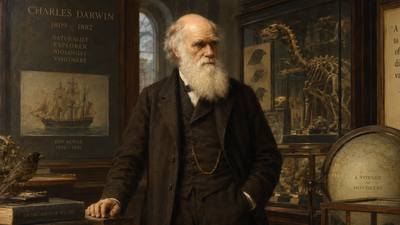
Charles Darwin, the English naturalist whose theory of evolution by natural selection transformed our understanding of life, also left behind observations that extended beyond biology. One of his most memorable reflections was on the value of time and how people choose to use it. His words, “A man who dares to waste one hour of time has not discovered the value of life,” offer a simple reminder that time is among the most limited resources a person has. The quote remains relevant more than a century after Darwin’s death, particularly in an age when distractions can consume hours without us noticing.
Quote of the day by Charles Darwin
“A man who dares to waste one hour of time has not discovered the value of life”Darwin’s observation connects the way people treat time with the way they value their own lives. The idea is not simply that every minute must be spent working or being productive. Rather, it suggests that understanding the importance of life also means recognising that time cannot be recovered once it has passed. A wasted hour, in Darwin’s sense, is an hour allowed to disappear without purpose or appreciation. The thought reflects a broader theme in Darwin’s life, which was marked by years of observation, experimentation, writing and careful study of the natural world.
The scientist who changed how we understand life
Born in Shrewsbury, England, in 1809, Darwin became one of the most influential figures in the history of science. His five-year voyage aboard HMS Beagle exposed him to an extraordinary range of plants, animals and geological formations, helping shape his ideas about how species change over generations. In 1859, he published On the Origin of Species, presenting his theory of evolution through natural selection. The work fundamentally changed biology by explaining how variations that help organisms survive and reproduce can become more common across generations.
Darwin spent years observing nature
Darwin’s scientific achievements were built on patience rather than quick conclusions. He spent decades gathering evidence, studying specimens and corresponding with other researchers before publishing his theory of natural selection. His observations ranged from earthworms and barnacles to orchids, birds and mammals. He carefully recorded small details that could reveal larger patterns in nature. His approach demonstrates why scientific discovery often depends on giving ideas time to develop and being willing to examine evidence repeatedly.
What the quote says about wasting time
The meaning of Darwin’s words can be interpreted beyond productivity. An hour spent resting, spending time with family, observing nature or simply doing something meaningful is not necessarily wasted. The deeper message is about recognising the finite nature of time. Once an hour has passed, it cannot be recovered or stored for later use. In that sense, the quote encourages people to become more conscious of how they spend their days rather than allowing time to disappear unnoticed.
Darwin’s words still resonate today
Darwin died in 1882, yet his ideas continue to influence biology, medicine, ecology and evolutionary research. His observation about time has also taken on a broader relevance in modern life, where constant notifications, social media and digital entertainment can easily consume attention. The quote serves as a reminder that life is measured not only by major achievements but also by the countless hours that make up a lifetime. Recognising their value can encourage people to spend those hours more deliberately.