

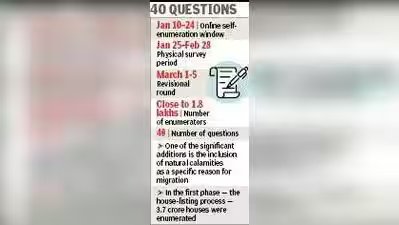
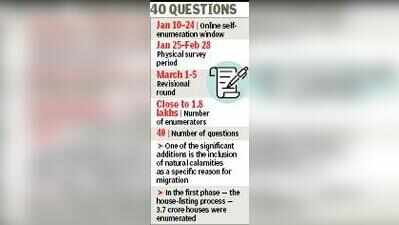
Kolkata: Starting Jan 10, every household in Bengal will have 40 questions to answer — ranging from the mundane details of age, marriage and occupation to more revealing ones about caste, religion, migration history and even digital literacy.As the second phase of Census 2027 rolls out its self-enumeration exercise, residents will get the first opportunity to put their family details on record themselves, online, before nearly 1.8 lakh enumerators fan out across the state from Jan 25 for the door-to-door survey.The questionnaire also promises to be far more than a numerical headcount. From family relationships, marital status and occupation to caste, religion, mother tongue, digital literacy and migration history, the exercise will attempt to build an expansive picture of how Indians live, work, move and identify themselves.One of the significant additions is the inclusion of natural calamities as a specific reason for migration. For a state like Bengal, where riverbank erosion, recurrent flooding and cyclones have displaced families across districts, the question could help capture a dimension of migration that has often been difficult to quantify separately.While the first phase of the census — the house-listing process, in which 3.7 crore houses were enumerated — is already complete, the second and more crucial population enumeration will be conducted in two stages, with the initial self-enumeration window allowing households to voluntarily enter their particulars online between Jan 10 and Jan 24. The house visit will begin from Jan 25 to Feb 28, when census enumerators will collect and verify information, including details from families that have not opted for online self-enumeration.“We will have more number of enumerators this time as compared to the house listing exercise. Further, we have more clarity on who all can be recruited as enumerators other than just teachers. This will help us with better work distribution,” said a senior Census official.The 40-question questionnaire will cover several aspects of individual and household life. Alongside conventional questions on names, age, sex, marital status and relationships with the head of the household, the expanded set of particulars will seek information on spouses and declared nationality.The social and cultural profile will include religion, mother tongue, literacy and caste particulars. Scheduled Castes and Scheduled Tribes will have designated categories, while other castes will be recorded through an open-ended response. A new question on digital literacy will also seek to capture how far technology has penetrated everyday life.The questionnaire will delve into occupational and economic details, including workers’ classifications and commuting patterns. Migration-related questions will seek information on place of birth, previous residence and the reasons behind relocation.“There will also be a closer look at family roots. New particulars include permanent residential addresses and the place and date of birth of both parents — information that could help build a more detailed picture of family origins and geographical mobility,” the official added.The questionnaire will additionally cover fertility-related particulars, including child survival and birth details for eligible women, besides asking about the place of Covid-19 vaccination.Another expanded section will seek details about banking and identification facilities, including the number of bank accounts, mobile number, Aadhaar, voter ID and passport particulars, as well as whether a respondent possesses a driving licence.