








Quote of the day by Benjamin Franklin: “What is more valuable than gold? Diamonds. Than diamonds? Virtue.” |

Benjamin Franklin (Image: Wikipedia) Two people can spend a lifetime accumulating whatever they consider valuable and end up with completely different kinds of wealth to show for it. One collects money, property, and possessions, each one clearly priced, each one able to be counted. The other spends that same effort building something that resists being…

Read More

America is turning decades-old radioactive waste into strontium-90 power systems that could keep underwater sensors running for decades |

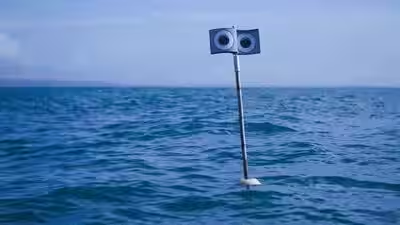
America is quietly building a network of nuclear-powered nodes on the ocean floor that could charge drone submarines for close to three decades without a cable, a support ship or a single resupply run. The fuel behind this project is strontium-90, a radioactive by-product that has sat in government storage for decades, and the Pentagon…

Read More

Archaeologists in Málaga uncovered a 13-metre megalithic tomb more than 5,000 years old; ivory, amber and seashells point to long-distance exchange networks

Photo credit: University of Cádiz Archaeologists working near Teba in Málaga, southern Spain, have uncovered a remarkably well-preserved megalithic tomb that is more than 5,000 years old. Announced by the University of Cádiz, the structure, known as Dolmen I of the La Lentejuela necropolis stretches about 13 metres, or roughly 42 feet, and contains multiple…

Read More

Earth’s core contains most of the planet’s gold, and scientists now find evidence that some core material is leaking into the mantle |

Earth’s core holds far more gold than anyone can reach. More than 99.999 per cent of the planet’s stores of gold and other precious metals lie buried under 3,000 kilometres of solid rock, locked away within the metallic core and far beyond the reach of humankind. For decades, geologists assumed this vast reserve was permanently…

Read More

Quote of the day by Alexander Graham Bell: “Great discoveries and improvements invariably involve the cooperation of many minds” |

Alexander Graham Bell is best remembered for helping develop the telephone, an invention that transformed how people communicated across distance. Yet Bell himself recognised that major breakthroughs rarely belong entirely to one person. His statement, “Great discoveries and improvements invariably involve the cooperation of many minds”, reflects the collaborative nature of scientific progress. Bell worked…

Read More

The world’s largest solar telescope resolved the Sun at about 19-km scale and revealed ubiquitous plasma vortices that may help explain how magnetic energy moves

The observations were made with the Daniel K. Inouye Solar Telescope (DKIST), a powerful 4-metre class solar telescope operated by the US National Science Foundation. The Sun may appear to us on Earth as a glowing ball of plasma, but its surface is far more active and turbulent than it looks, which has been proven…

Read More

Wyoming’s Casper landfill buried 1,124 turbine blades after each was cut into three pieces; a Missouri plant offers another route by turning old blades into cement feedstock

Outside Casper, pieces of turbine blades cut through were lowered by a loader into a trench for years. Now, what they are being used for instead of being buried under the ground, is to make cement powder. And this transition is worth noting.The Casper Regional Landfill took its first decommissioned blades in the spring of…

Read More

In 2013, honeybees were trained to find land mines left behind by the Balkan wars, turning their extraordinary sense of smell into an unlikely detection tool |

Croatia was still dealing with the hidden legacy of the Balkan wars when scientists began looking to an unlikely ally: honeybees. Years after mines had been buried across fields, forests and rural land, uncertainty over their locations continued to complicate farming, development and everyday life. Traditional mine-clearance teams faced the difficult task of finding explosives…

Read More

Florida scientists are turning rice husk waste into reusable water filters that can remove pollutants from contaminated water |

Rice leaves behind more than a meal. After the grain has been processed, the tough outer husk is usually treated as an unwanted agricultural residue, with enormous quantities accumulating every year. Much of it has little obvious use and can become an environmental burden when it is burned or dumped. At Florida International University, chemistry…

Read More