






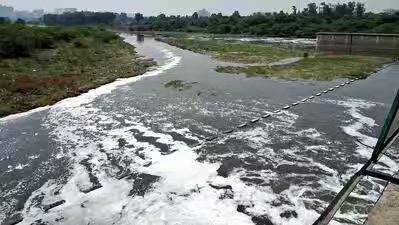
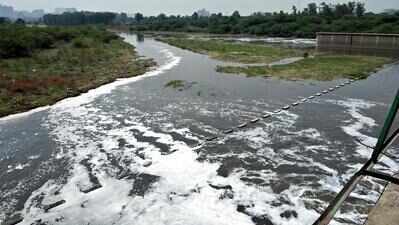
Ghaziabad: Cases have been registered against 13 officials, including civic body staffers from Ghaziabad, Meerut, Saharanpur, Loni Nagar Palika and Greater Noida Industrial Development Corporation, for failing to check Hindon pollution, Uttar Pradesh Pollution Control Board told National Green Tribunal (NGT) in an affidavit filed on Oct 31.The case was registered under Section 43 of the Water (Prevention and Control of Pollution) Act, 1974, which prescribes a minimum imprisonment of one year and six months that may be extended to six years, and a fine.The board filed the affidavit after the principal bench comprising NGT chairperson Justice Prakash Shrivastava and expert member Afroz Ahmad, while hearing a petition of environmentalist Abhisht Kusum Gupta on Aug 17, had directed it to disclose the names and full particulars of the officials against whom those complaints have been filed.The affidavit also lists the status of 20 STPs across the Hindon basin that were discharging water into the river.“Of the 20 STPs, eight were found to be non-compliant during a joint inspection carried out by a committee comprising CPCB and UPPCB officials between Sept and Oct this year on the direction of NGT. In Ghaziabad, two 56 MLD STPs, both in Indirapuram, and one 70 MLD STP in Dundahera were found to be non-compliant,” an UPPCB official said.In one of the 56 MLD STPs in Indirapuram, where inspection was carried out on Oct 7, total coliform in treated water was found to be 3,400 MPN/100 ml. In another 56 MLD STP plant in Indirapuram, the inspection by the joint committee was carried out on Oct 13, and total coliform in treated water was found to be 2,200 MPN/100 ml, while in the 70 MLD STP plant in Dundahera, total coliform was 4,900 MPN/100 ml, the affidavit states.UPPCB does not prescribe a separate permissible limit for total coliform in STP treated-effluent discharge standards. A MoEF&CC notification of Oct 2017 specifies that the faecal coliform (FC) limit should be less than 1,000 MPN/100 ml.On Oct 8, UPPCB analysed water samples of the river at three spots in Ghaziabad. At Karhera station, the faecal coliform was recorded at 280,000 MPN/100 ml and total coliform was 350,000 MPN/100 ml. At Hindon Bridge station, faecal coliform was recorded at 340,000 MPN/100 ml and total coliform at 390,000 MPN/100 ml. At Chhijarshi station, faecal coliform was 270,000 MPN/100 ml and total coliform 340,000 MPN/100 ml.“This is the condition of treated water from STPs, which are drained in the river. It is no surprise that NGT has taken such a stern stand against the officials who have been playing with the health of the river for so long,” the petitioner said.A GMC official, meanwhile, said, “There is a sewage network of 2,488 km within the city area, and close to 3.50 lakh population is connected to the sewer network. As for the plan under the Ghaziabad Sewerage Scheme (Karheda Zone) under AMRUT 2.0, Rs 546 crore projects were being undertaken. These projects are 82% complete.”