









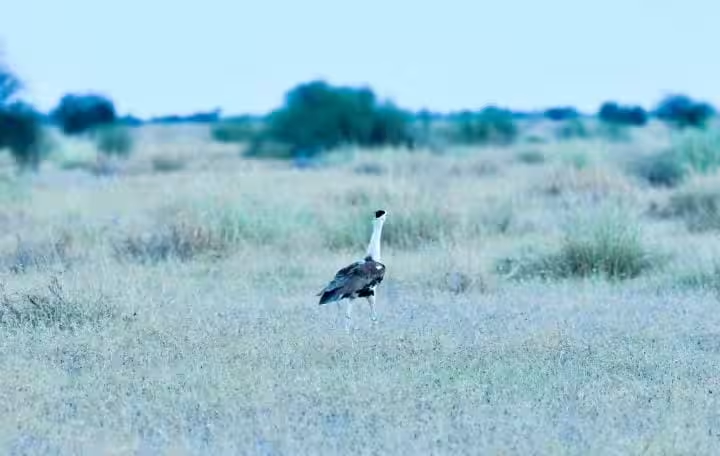
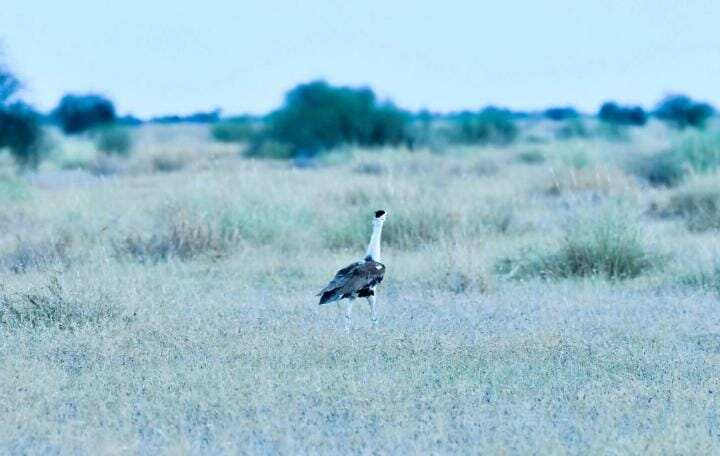
Jaisalmer: In a major step for the conservation of the critically endangered Great Indian Bustard, two captive-bred birds released experimentally into the wild at Desert National Park in Jaisalmer continue to be safe and healthy, giving India’s first such rewilding pilot an encouraging start.The two Great Indian Bustards, Rajasthan’s state bird and locally known as Godawan, were released Sunday from a fenced closure at GIB Conservation Breeding Centre at Sudasari in Desert National Park. The release marks India’s first experimental transition of captive-bred GIBs towards free-ranging in the wild.Wildlife Institute of India (WII) experts are tracking both birds through satellite tags and advanced monitoring systems. Their movements, habitat use and behaviour are being watched continuously from a control centre at Sam breeding centre.Institute director Govind Sagar Bharadwaj said the birds are flying within Desert National Park area. One of them has also used a water gajjar, an artificial water source, and drunk water, he said.For a species pushed to the edge, the early behaviour is significant. The success of such a release depends not just on survival, but on whether captive-bred birds begin using the landscape, finding water and moving safely through their natural habitat.Bharadwaj said WII and DNP administration are working to secure the release area and reduce disturbance.“Our focus is on protecting the area so that there is no unauthorised grazing in the movement range of the two GIBs and their natural habitat is not disturbed,” he said.The team is also monitoring artificial water sources created by the forest department to meet the birds’ drinking-water requirements.A critical safety factor, Bharadwaj said, is the absence of high-tension power lines in the free-ranging area. Such lines are towards Sam and other parts of Jaisalmer, but not in the area where the two birds have been released.“The power lines are towards Sam and other parts of Jaisalmer. Therefore, the free-ranging area does not pose a threat to the released GIBs from high-tension wires,” he said.WII is now preparing to release more captive-bred GIBs in the next phase of the pilot project in the coming days. Bharadwaj said nine older captive-bred birds — five males and four females — have already been identified for future release.“These birds are among those that will be released first. We are preparing more GIBs for free-ranging and will implement the next phase of the pilot project in the coming days,” he said.The phased release is designed to help captive-bred GIBs gradually move towards independent survival in their natural habitat. It will also generate scientific evidence for scaling up the country’s GIB rewilding programme.