








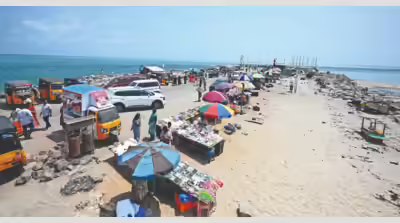
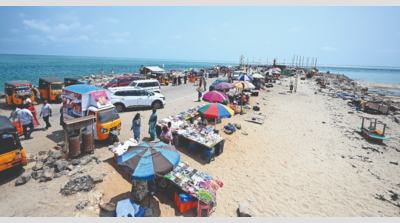
As the sun rises and the horizon melts into the sea, Dhanushkodi stirs to life. Hawkers begin to line the narrow road flanked by the sea, fishermen return to the shores with their catch, tourists and pilgrims arrive in steady streams. For decades, Dhanushkodi’s story was one of neglect and abandonment. That began to change after 2017, when the road link brought in tourists. What was once a thriving town has since taken on an eerie, fragile beauty. Today, 200 families have returned, carving out a life amid the ruins. With no electricity, drinking water, or mobile connectivity, survival here is basic and precarious. Perched at the tip of Rameswaram island in south Tamil Nadu, Dhanushkodi sits dramatically at the confluence of Bay of Bengal and Indian Ocean. But the ghost town remains suspended in time, its long-promised makeover elusive. Connectivity has improved in recent years. A new bridge alongside the 112-year-old Pamban bridge was inaugurated a year ago, and a 9.5km road linking Rameswaram to Arichalmunai, laid in 2017, opened the area to visitors. But the town remains largely uninhabitable, a stark reminder of the devastating cyclone of Dec 1964 that wiped it off the map. Development has been slow, constrained by environmental concerns. The region falls within an ecologically sensitive zone and is now part of the Gulf of Mannar Biosphere Reserve. The declaration of a greater flamingo sanctuary last year has tightened restrictions. High costs and regulatory hurdles have stalled infrastructure projects, while eco-tourism initiatives have taken precedence. Even as the town draws crowds, its residents live on the margins. About 3,000 families cling to Dhanushkodi’s remnants, though only 350 live here permanently, dependent on solar panels that provide limited electricity, and private vans that bring drinking water for `1 per litre. The lone panchayat union middle school stands in a state of disrepair, its rusting iron beams and zinc-sheet walls forcing students to study outdoors under trees. The town with toddlers and elderly has no medical facilities. In 2024, state public health experts flagged the absence of primary health care, sanitation, and emergency services in the disaster-prone coastline in the Tamil Nadu Journal of Public Health and Medical Research. They said any redevelopment blueprint must first secure housing, safe water and a health outpost for residents, before chasing large tourism projects in this fragile border town. A few nautical miles away lies Talaimannar in Sri Lanka’s northern province. Arichalmunai has long been a point of clandestine crossings, once used by illegal ferries transporting Sri Lankan Tamil refugees. While such activity has reduced with increased vigilance, it has not ceased. For many, survival depends on the sea. K Kanges travels daily from Rameswaram to fish. Having witnessed the spillover effects of the Sri Lankan civil war, the 45-year-old is part of an informal vigilance group. “We alert authorities if we see anything suspicious,” says Kanges. He recalls stories of Dhanushkodi as a once-thriving hub, “like a Singapore”. Fishing is the backbone of the local economy. About 125 families run makeshift stalls selling trinkets and seafood meals under thatched roofs, catering to the growing tourist footfall. Nature, meanwhile, reclaims its space. Peafowl roam freely, their calls breaking the stillness. Residents feed them biscuits, a telling image of adaptation in a place caught between ruin and resilience. Successive govts are yet to unfold a clear plan to the town. After the 1964 cyclone horror in which 2,000 people were believed to have died, and a train with passengers was swept away into the sea, the town continues to wait – to be rebuilt.