




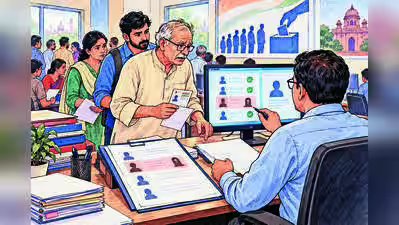
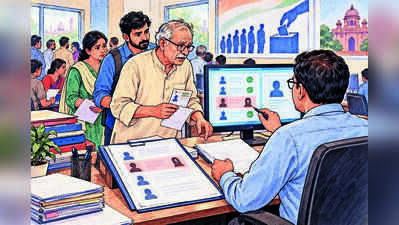
Ghaziabad: Camps will be set up in the city, which saw a 20% downsizing of the electorate in the special intensive revision (SIR) of electoral rolls earlier this year, to register voters who did not make it to the final roll as well as first-time voters. The camps will be held on Oct 17 and 24. DM Ravindra Kumar Mandar said the regular Form 6 will be used during the exercise, with no declaration of parents’ details required. Carrying EPIC, he said, was optional as it helped keep families under one booth.Ghaziabad saw the second-highest deletions in the final rolls, published on April 10, in the state in percentage terms after capital Lucknow (22.9%). While 5.7 lakh names were removed from Ghaziabad’s list, Lucknow saw 9.1 lakh deletions. UP’s electorate was itself downsized by a little over 2 crore voters — a shade less than the population of Sri Lanka.Sahibabad, the state’s largest constituency by population, saw 30.4% deletions that shaved off 3.2 lakh names, the highest for an assembly segment in the state. Noida followed with 23.9% (1.8 lakh) deletions. Across Gautam Budh Nagar, 3.6 lakh names were removed from the final rolls.The camps are being organised following directions from the Election Commission of India amid a raging row over deletions from electoral rolls during SIR, which have led to calls for the resignation of Chief Election Commissioner Gyanesh Kumar by the Opposition as well as Cockroach Janta Party (CJP).Mandar, who is also the district election officer, said BLOs would be available at every polling station from 10 am to 4 pm on both days. Help desks will also be set up at the polling stations to assist applicants in filling out Form 6, which is used for registering new voters.Anjani Kumar Singh, additional district magistrate (finance and revenue) and deputy district election officer, said residents seeking to enrol their names need self-attested photocopies of their photograph, proof of date of birth and residence-related documents. If available, they should also carry the Elector Photo Identity Card (EPIC) number of a family member to facilitate the application process.“We will be using the Form 6 used during the non-SIR period for the special camps. There will be no declaration form required where voters need to provide details of their parents or grandparents,” Mandar told TOI. Form 6 is prescribed under the Registration of Electors Rules, 1960, which have been framed under Section 28 of the RPA, 1950.He added that carrying the EPIC number of a family member makes it easier to put all members of a family in the same booth, but was not compulsory. “Sometimes there can be two booths within 2km, and it separates members of the same family. To ensure all members come under one booth, those who have EPIC can bring it,” he said.The new Form 6 came under controversy over allegations that changes were introduced into the voter registration process without following the prescribed legal procedure.The new Form 6 has come under controversy over allegations that changes were introduced into the voter registration process without following the prescribed legal procedure. The new form requires applicants seeking registration as new voters to state whether they or their parents were mapped in the previous SIR (2002). The earlier Form 6 used during electoral roll revisions did not seek such a declaration.Officials said each polling station will have a help desk to assist applicants in filling out forms. BLOs will also have copies of Form 6, the final electoral roll published on April 10, 2026, and all supplementary lists published subsequently. The administration has directed officials to maintain proper records of applications received during the camps.The administration will publicise the registration drive through multiple channels to reach residents in both urban and rural areas. In cities, announcements will be made through loudspeakers mounted on rickshaws, while traditional drum announcements will be used in rural areas.To monitor the exercise, the district election officer will personally supervise arrangements at five polling stations, while the deputy district election officer will inspect 10. Electoral registration officers will visit 10% of polling stations in their respective assembly constituencies. Other officials will also inspect camps to review arrangements and ensure that the drive is conducted according to schedule.