







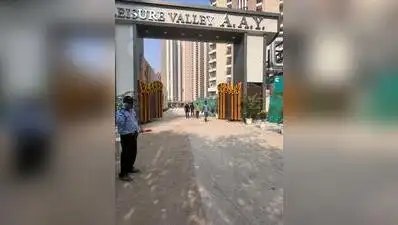
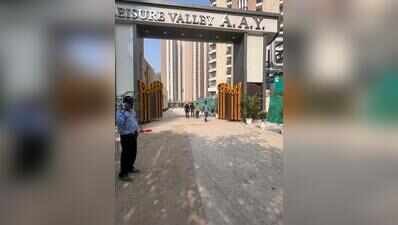
Noida: Possession letters began to be handed over to homebuyers on Friday at Phase 1 of Adarsh Awas Yojana in Amrapali Leisure Valley, even as 86 other projects across Gautam Budh Nagar and Ghaziabad remain stuck in insolvency proceedings, a decade after the Insolvency and Bankruptcy Code (IBC) came into force in 2016.Supreme Court-appointed court receiver R Venkataramani handed over no-objection certificates (NOCs) and possession letters to 51 homebuyers from three towers — A1, G1 and H1 — of the project’s eight. National Buildings Construction Corporation (NBCC) said keys to these buyers were proposed to be handed over within 30-45 days.Noida Extension Flat Owners Welfare Association (NEFOWA) vice president Dipankar Kumar, a homebuyer in the project, said the wait had been long. “After nearly 14 years of waiting, the handover process has begun. It was a long fight and a long wait,” he said.The case dates back to 2017, when Amrapali’s parent company, Ultra Homes Construction Private Limited, first approached National Company Law Tribunal (NCLT). An insolvency resolution professional (IRP) was then appointed for all its associated companies.The same year, NEFOWA challenged an IBC provision under which homebuyers were not treated as financial creditors for residential projects. The petition, filed under Article 21 of the Constitution, stated that buyers risked getting nothing if a company went into liquidation. On Aug 17, 2018, Parliament passed the Insolvency and Bankruptcy Code (Second Amendment) Act, 2018, to treat homebuyers as financial creditors.On Aug 9, 2019, in Pioneer Urban Land and Infrastructure Ltd vs Union of India, Supreme Court upheld the amendment’s constitutional validity.“The SC accepted our argument and cancelled the RERA registration of all companies of the Amrapali Group and took the entire company under its control,” Kumar said.He said the insolvency process itself had been a major hurdle for stuck projects.“The biggest drawback of the law is that after the IRP is appointed, its focus remains on withdrawing its salary or collecting money in other ways instead of reviving a project. An insolvency case can go on for years and years, and homebuyers’ money and flats remain stuck,” he said.Of the 86 projects under NCLT, 56 are in Gautam Budh Nagar and 30 in Ghaziabad, covering both residential and commercial schemes. Some have been languishing since 2019.Insolvency expert Sumit Khanna said the delays had defeated the purpose of the law. “The IBC was built around a deadline. A resolution had to be completed in 180 days, stretched to 330 at the latest. A decade in, a case that ends in an approved resolution plan takes 633 days on the regulator’s own count. Measured from admission to approval, it is closer to 750,” he said.Khanna said three-quarters of the cases in NCLT today have been running past 270 days. He identified two main causes of delay. The first is the time taken to admit a case. The IBC gives the tribunal 14 days to confirm that a default has occurred, but courts read this as guidance and not a binding limit.“Admission has routinely taken a year or more,” he said.The second cause, he said, is litigation used as a tactic. “Almost every step can be challenged. The admission, the committee of creditors, the valuation, the treatment of a claim, the eligibility of a bidder. Each is heard by a tribunal and each can be appealed,” he said.Staffing is also a concern. The tribunal’s sanctioned strength of 63 has not changed since it was set up and it has worked with 52 since July, Khanna said. A parliamentary panel reported in Aug that insolvency accounts for more than half of the tribunal’s caseload and that over 95% of its staff are on contract.Earthcon Universal Infratech director Shadab Khan said backing from authorities could speed up revival. “If the builder demonstrates a clear intent to complete construction, the support of the development authority and RERA, entities that homebuyers also trust, can play a vital role in facilitating a swift revival,” he said.UP Rera chairperson Sanjay Bhoosreddy said a project moves out of the regulator’s reach once it goes to the tribunal. “The real estate regulatory authority monitors projects but when a project goes to NCLT it does not remain in its jurisdiction,” he said.