







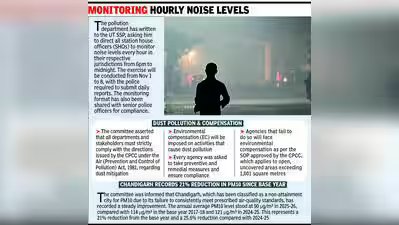
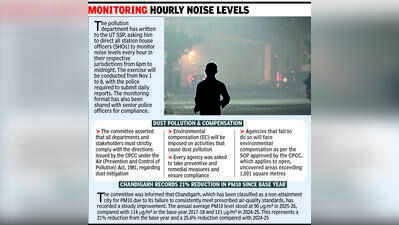
Chandigarh: With winter approaching and concerns over air quality intensifying, the Chandigarh administration has drawn up a coordinated plan involving all major departments to mitigate dust pollution.The Chandigarh Pollution Control Committee (CPCC), while reviewing preparations under the National Clean Air Programme (NCAP), has outlined a series of measures for the municipal corporation, Chandigarh Police, Chandigarh Traffic Police, engineering department and education department to improve air quality during the winter months.Sharing minutes of the 13th meeting of the Air Quality Monitoring Committee (AQMC), held on Oct 28, the CPCC on Friday detailed the steps to be taken by various departments, including deployment and regulated use of mechanised road sweepers, water sprinklers, fogging machines and anti-smog guns.The committee was informed that the MC has deployed four mechanised road sweepers, covering about 240 km per day. Total of 11 water sprinklers, fogging machines and anti-smog guns have also been deployed across the city.“The committee identified main winter pollution sources as calm conditions and temperature inversion, festival traffic, firecrackers and biomass, including stubble burning. It stressed that regulated use of the new machines is critical from Nov 2026 to March 2027. The MC will run all NCAP machines strictly as per the SOP and CPCC guidelines. Each machine will have a daily logbook supported by photographs or GPS records. Machines will be deployed on priority at hotspots, major roads and C&D sites. They will not be diverted to other uses, and only trained and authorised operators will run them. Any machine idle for more than three days will be reported to CPCC,” the CPCC said while releasing the minutes of the meeting.It was further stated that sweeping will be planned on major and arterial roads, preferably at night or during low-traffic hours. Dry sweeping that raises dust will be avoided. Collected dust will be disposed of only at authorised sites, while daily coverage of about 240km will be monitored against the planned route.Sprinklers, fogging machines and anti-smog guns will be used at hotspots during dry, dusty and calm conditions, without causing waterlogging or making roads slippery. They will not be operated on rainy days or during periods of very high humidity. Tree canopy washing will follow a fixed schedule, with operating hours and water consumption recorded.The CPCC will also audit machinery every fortnight. The audits will cover availability and deployment, logbooks and coverage, water use, dust disposal, maintenance and spares, and operator training.“The MC must fix any deficiencies within the stipulated time and submit an action-taken report before the next audit. Findings will be reported to the AQMC at each meeting. The MC will conduct workshops and training, as required, for MC supervisors, sanitation staff, drivers and assistants of NCAP vehicles in coordination with the CPCC,” the official statement said.Besides the MC, the Chandigarh Traffic Police has been asked to conduct a city-wide awareness campaign involving eco-clubs, resident welfare associations, market welfare associations and NGOs. It has also been asked to make regular announcements through Integrated Traffic Management System (ITMS) at traffic intersections and other prominent locations.The education department has been requested to raise awareness among students in all govt and private schools. Suggested activities include school assemblies, eco-clubs, seminars, poster-making and slogan-writing competitions, and special sessions. Students may also act as ambassadors of environmental awareness in their families and communities.Box 1: Monitoring hourly noise levelsThe pollution department has written to the UT SSP, asking him to direct all station house officers (SHOs) to monitor noise levels every hour in their respective jurisdictions from 6pm to midnight. The exercise will be conducted from Nov 1 to 8, with the police required to submit daily reports. The monitoring format has also been shared with senior police officers for compliance.Box 2: Dust pollution & compensation–The committee asserted that all departments and stakeholders must strictly comply with the directions issued by the CPCC under the Air (Prevention and Control of Pollution) Act, 1981, regarding dust mitigation–Environmental compensation (EC) will be imposed on activities that cause dust pollution–Every agency was asked to take preventive and remedial measures and ensure compliance–Agencies that fail to do so will face environmental compensation as per the SOP approved by the CPCC, which applies to open, uncovered areas exceeding 1,001 square metresBox 3: Chandigarh records 21% reduction in PM10 since base yearThe committee was informed that Chandigarh, which has been classified as a non-attainment city for PM10 due to its failure to consistently meet prescribed air-quality standards, has recorded a steady improvement. The annual average PM10 level stood at 90 µg/m³ in 2025-26, compared with 114 µg/m³ in the base year 2017-18 and 121 µg/m³ in 2024-25. This represents a 21% reduction from the base year and a 25.6% reduction compared with 2024-25.