









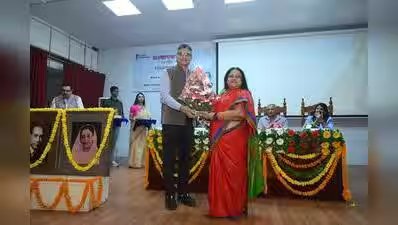
Lucknow: The Birbal Sahni Institute of Palaeosciences (BSIP) has unveiled its ambitious Brahma AI Mission, aimed at using Artificial Intelligence for fossil identification, digital fossil documentation and palaeoclimatic modelling, as the institute celebrated the 135th birth anniversary of its founder, renowned palaeobotanist Prof Birbal Sahni.Addressing the Founder’s Day function, BSIP director Prof MG Thakkar said the institute was witnessing strong scientific growth, with nearly 200 research papers published during 2025-26, including several in high-impact journals. “The Brahma AI Mission will open new avenues in fossil identification, digital fossil documentation and palaeoclimatic modelling, while helping strengthen BSIP’s position at the forefront of palaeoscience research,” he said.The institute also highlighted preparations for the XXII INQUA Congress 2027, to be held in Lucknow from Jan 28 to Feb 3, marking the first time the prestigious international event will be hosted in the Indian subcontinent.Chief guest A Dhanalakshmi, joint secretary, department of science and technology, called for greater emphasis on demand-driven research with societal applications, while UP archaeology director Renu Dwivedi proposed closer collaboration with BSIP in archaeobotanical and archaeological studies.A special volume of Geophytology was released during the event. The celebrations also featured the 56th Birbal Sahni Memorial Lecture by Prof Nishith A Dharaiya on wildlife conservation and the 68th Sir A C Seward Memorial Lecture by Prof Bineesha Payattati on biomimicry-inspired circular economy and waste management.Among the major awardees, Dr Santosh K Shah won the Best Paper Award (shared with Dr Parminder Singh Ranhotra), Highest Cited Paper Award and Global Recognition Award. Dr Swati Tripathi received the Highest Number of Publications Award and National Recognition Award, while Dr Mohd Firoze Quamar shared the Highest Number of Publications Award.