









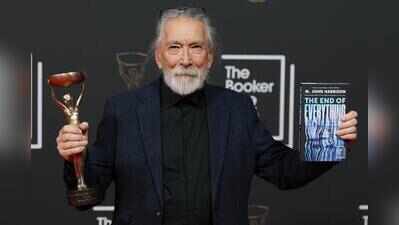
British author M John Harrison, who won the 2026 Booker Prize for his latest science fiction novel, ‘The End of Everything’, capping a writing career spanning more than 60 years, told TOI Bookmark he had not expected to win even after making the shortlist, and was shocked and confused for about two minutes after the announcement. In fact, he has been writing since the Booker Prize itself has been in existence.For ‘The End of Everything’, Harrison favoured compressed, unobtrusive world-building, he said. He set it on the Kent coast, a landscape he knew intimately and could present sharply and economically. “I’m deeply interested in form, and I’m interested in breaking it, rearranging it. I’m interested in voice; every sentence should have a voice,” he said.The novel took between 10 and 15 years to develop. For more than half that period, Harrison, who is now 81, was unsure whether the material would become a book. Artificial intelligence and large language models became themes, particularly through an artefact recovered from the sea. As public controversy over the technology developed, he revised the opening and strengthened those elements so readers would not see them as accidental.The book also comments on business culture, including the belief that commercial expertise transfers to unrelated disciplines, he said. He dismissed the idea that the only way to pull a reader is through an exciting narrative. “You can write about anything, as long as you can engage the reader’s attention,” he said.Harrison criticised the industrialisation of fiction and publishing’s preference for categories and comparisons with existing books. While some generic writing could transcend its remit, he said fiction should offer something new and help readers think differently.Growing older had given him greater freedom and patience, Harrison said. At about 65, he became more determined to own his work and write as he wished, while awareness of limited time added urgency. “The advantage of age is that, weirdly enough, although life seems to be shortening for you, you’ve got more patience than you had with everything you do.”He said the Booker recognition was gratifying but disorienting after a lifetime without major acclaim and would help him sell more books to publishers and readers. However, he wished it had come when he was 40 and could have shaped a different career.He hoped the award would encourage younger writers to resist publishing constraints and pursue individual styles. His work at British speculative fiction magazine New Worlds in the 1960s and 1970s had encouraged his interest in challenging literary conventions.Harrison sold his first story in 1965 and joined New Worlds in 1969, editing its books pages until 1978. His novels include Climbers, Nova Swing and The Sunken Land Begins to Rise Again. He was a Booker Prize judge in 2022.