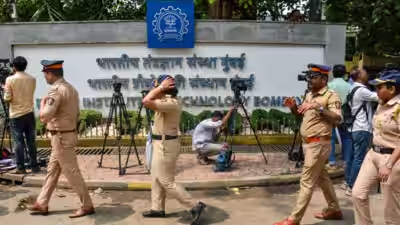










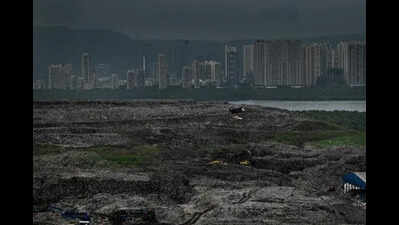
Mumbai: The Bombay High Court on Monday directed the BMC administration to scientifically monitor between 1am and 6am the reasons behind odour rising in the vicinity of the Kanjurmarg landfill treatment facility and to map how far it travels. The HC also said the Maharashtra Pollution Control Board (MPCB) should monitor the different kinds of emissions from adjoining industries, keep and display a record of the readings, which would help with an action plan. The BMC, in an affidavit and through its senior counsel Anil Sakhare in court, informed the HC that it has appointed an expert committee comprising specialists from IIT-Bombay and NEERI as consultants to study a recent report of high methane levels at Kanjurmarg dumping ground and advise it on ways to address the issue. The HC division bench of Justices Girish Kulkarni and Aarti Sathe, fresh from a surprise visit to the Kanjurmarg site on April 25, said their main concern is to ensure that methane, a natural byproduct at a landfill, doesn’t adversely affect thousands of citizens in the neighbourhood, but is tapped and put to productive use.Justice Kulkarni said, “…methane is odourless, but extremely dangerous… a cause for global warming,” and reiterated that its concern is also since the site is in the city, but acknowledged that the BMC was tapping methane to produce power at the site. The judges said their visit proved to be a “learning exercise”, appreciating how civic officials and the contractor explained the measures undertaken. “The visit helped us better understand everything,” said Justice Kulkarni, and asked the BMC to also take MPCB counsel R V Govilkar to the site on Friday. The HC was hearing two petitions — the original public interest litigation (PIL) filed in 2009 by NGO Vanashakti through its director D Stalin and a petition by Kannamwar Nagar cooperative housing society — highlighting pollution concerns from the Kanjurmarg landfill and the need to preserve mangroves. Justice Kulkarni orally said, “One thing during our visit was certain. We saw so many birds and flamingos in the lush green mangroves that stretched for miles one on side of the highway … the petitioners were absolutely right about the greenery that stretches there and attracts migratory birds, both of which need protection.““Our second concern is odour,” said the bench, adding, “BMC affidavit is absolutely silent on the PIL petitioner’s concern on the disturbing presence of odour.” The HC also expressed dissatisfaction at the contractor’s steps at odour mitigation. “The odour is stark in the wee hours from 1am to 6am,” said Vanshakti counsel Zaman Ali. The HC asked, “How many families are affected?” Kannamwar Nagar itself has a population of 15 lakh residents, said their counsel Kulkarni and advocate Abhijeet Rane.The judges said they appreciated the way senior civic officials explained the waste treatment and mitigation steps at BMC’s Integrated Waste Management Facility at the Kanjurmarg site. Saket Mone, for the waste management contractor Antony Lara Enviro Solutions Pvt, said methane is tapped and used for a biomethanation project to produce biogas.Sakhare said the BMC intends to undertake mitigation steps to ensure citizens are protected from any health hazards and will begin tree plantation at the site. Justice Kulkarni said, “Go ahead, but do a realistic plantation.”Additional municipal commissioner Bipin Sharma and deputy municipal commissioner Kiran Dighavkar were present in court.The HC asked the BMC to remove three paragraphs from its affidavit which were “very adversarial” in nature, questioning the petitioner’s reliance on a news report of high methane.“The articles are quite serious. We do not find that the ill-effects of such emission, caused due to the mismanagement of the dumping site, have been adequately addressed. If these ill-effects are not being addressed and stringent corrective measures are not being taken by the committee appointed by us or by the officers of the Municipal Corporation, then, in such circumstances, considering that human life is paramount, in the light of the provisions of Article 21 of the Constitution of India which stare at the state government and the municipal authorities, there would be no alternative for the court but to restrict/stop the activities at the present site.The bench warned: “We caution both the municipal and state authorities about the seriousness of the situation…if drastic orders are required, state and municipal authorities shall start working towards identifying an alternative site so that the dumping activities can be shifted to a location that is not adversely affecting human life/habitation. Such operations can, at least partly, be transferred to such a site, in our prima facie opinion.“