







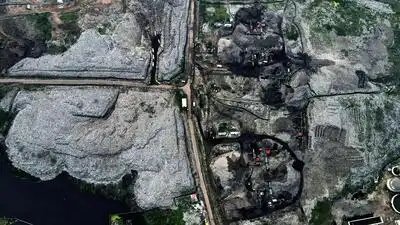
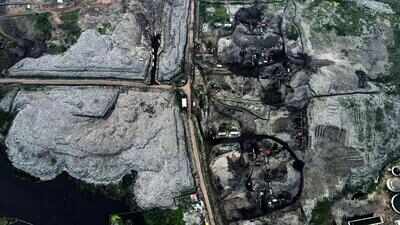
As Greater Chennai Corporation (GCC) focuses on clearing decades of accumulated garbage from major dumpyards at Kodungaiyur, Perungudi and Athipattu, the city’s decentralised waste processing has taken a hit, raising concerns over how fresh waste is being managed.A major chunk — 168 of 190 micro composting centres (MCCs) were shut following a council resolution on Feb 27, 2025. This reduced GCC’s 531 metric tonnes (MT) processing capacity to 115 MT. But the city continues to generate around 6,150 tonnes per day (TPD) of municipal solid waste. Of this, around 3,200 TPD is wet waste and 2,450 TPD dry waste.“Biomining is a necessary exercise to clear the legacy waste that has accumulated over 20 years and reclaim the land, but it cannot be treated as a complete or long-term solution to Chennai’s waste problem,” said Geo Damin of Poovulagin Nanbargal NGO. The exercise will be meaningless if fresh waste continues to be mixed with legacy waste and dumped,” he said.GCC is spending several hundred crores of rupees to clear the city’s legacy waste. At Perungudi, the second phase of biomining, covering 5.5 lakh MT, began in July and is expected to reclaim another 80 acres. At Kodungaiyur, 44 lakh MT of the 66.52 lakh MT of legacy waste has been cleared. GCC commissioner G S Sameeran has directed officials to expedite the work. The civic body has also planted 880 native saplings across three acres as part of ecological restoration.However, residents say waste continues to accumulate at dumpyards year after year. Beyond odour and dust, recurring fires and leachate contamination are adding to the environmental and public-health burden on nearby communities.“The real failure is not merely the existence of a dumpyard. It is the failure to establish a sustainable, decentralised waste-management system over several decades,” said D Neelakannan, president of the Tamil Nadu Alliance of Resident Welfare Associations. He said it must be based on segregation at source, processing close to where waste is generated, recycling, composting, biomethanation and scientific management of residual waste.Environmental activist K Raju and member of the Chennai Wetland Action Collective, said several MCCs had failed because of poor regulation and maintenance. “Many were burning waste inside burial grounds,” he said.However, he said the solution was to redesign and regulate decentralised waste processing rather than abandon it. Like how there are area sabhas in all wards, we need a decentralised composting centre, he said. “Composting infrastructure has to be customised, near fruit and vegetable markets, near industrial pockets,” he said. “The more we move into suburbs, we see waste dumped on roadsides. This needs constant coordination between GCC and CMDA,” he added.“The zones have been instructed to compensate for the capacity lost due to the MCC closures by utilising alternative wet-waste processing facilities wherever feasible,” said Sameeran. This includes two bio-CNG plants with 320 MT per day capacity, two windrow composting plants with 100 MT per day capacity, and two garden-waste processing plants with 160 MT per day capacity, together 580 MT per day.He said two more facilities have completed trial runs. “A 100 MT per day windrow composting plant at Perungudi and a 140 MT per day bio-CNG plant at Sholinganallur have both completed trial runs. That will add roughly 240 MT per day of capacity by the end of Sept,” he said.