









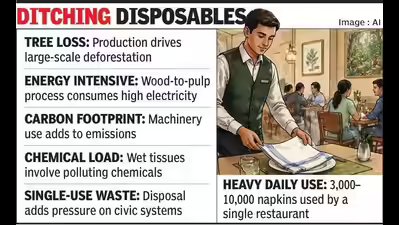
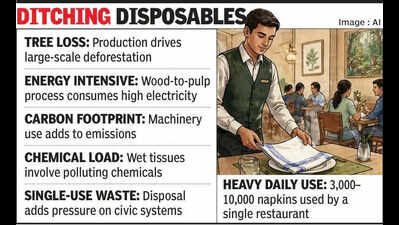
Rajkot: Bhavnagar is witnessing a quiet but meaningful shift in everyday habits, as an eco-conscious push to replace disposable tissue paper with reusable cloth napkins begins to take hold across hotels, eateries and community spaces. Driven by local activists, the move is emerging as a simple yet effective way to cut waste and reduce the environmental burden of single-use products.What began as a practical experiment has now grown into a city-wide conversation. The turning point came during a large religious gathering in Palitana, attended by lakhs of pilgrims, where organizers were confronted with the sheer volume of tissue paper required. “We estimated needing around 60,000 tissues for the event,” said environment activist Tejas Doshi, a state climate change awardee and Swachh Bharat Mission brand ambassador. “When you consider that nearly 24 trees are cut to produce a tonne of tissue paper, the scale becomes alarming. That’s when we decided to try cloth napkins — and the response was encouraging.”Since then, Doshi and fellow activists have been urging establishments to rethink their dependence on disposable napkins. A 35-room hotel-cum-restaurant on Vaghavadi Road, which had been experimenting with cloth napkins for the past two years, has now almost entirely phased out tissue paper.“Earlier, we used to buy six to seven boxes of tissues every month; now we hardly need one,” said manager Neetu Singh. Tissue paper is made available only on request, with staff gently nudging guests towards the reusable option. The establishment has also extended its eco-friendly practices by serving purified water in glass bottles instead of plastic.The numbers underline the impact such a shift can have. A mid-sized hotel or restaurant typically uses around 3,000 paper napkins a day, while larger establishments can consume up to 10,000. Replacing even a portion of this with cloth significantly reduces daily waste.Another prominent hotel in the city, part of a national chain, adopted the change earlier this year. Its general manager, Saibal Chetarjee, acknowledged a slight rise in operational costs due to additional laundry — about Rs 300 a day — but said the environmental benefits far outweigh the expense. “We’re doing this consciously for the environment, and guests have responded positively,” he said.Activists stress that the environmental cost of tissue paper extends beyond deforestation. “The production process itself consumes large amounts of water and involves chemicals, especially for wet tissues, which leads to pollution,” said Falguni Joshi, co-ordinator of Prayavaran Mitra. “It’s a single-use product, and its disposal adds to the carbon footprint.”Doshi also pointed out that such habits are often borrowed without context. “In colder countries, water can freeze, making tissues more practical. But in India, we have always used handkerchiefs. It’s a sustainable practice we should return to,” he said.As more establishments come on board, Bhavnagar’s shift to cloth napkins is proving that small, conscious changes in daily routines can collectively make a substantial environmental difference — offering a simple, scalable model for other cities to emulate.