






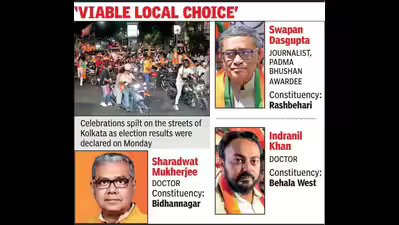
Kolkata: The ‘bhadralok’ neighbourhoods of Kolkata North and South decisively flipped and voted out the Trinamool govt. For over a decade, these very urban localities were considered impenetrable fortresses of the Trinamool. But the election results revealed a metropolitan electorate that traded its traditional allegiance for a “new beginning” under the BJP.Political science professor Maidul Islam said, “There has been a demographic shift in the past 15 years and BJP has remained the second-largest party in Kolkata North and South. The non-Bengali vote share has increased in Kolkata. Then, there are the high-rises, where residents are drawn to the idea of having the same party in the Centre and the state. Young voters, aged between 18 and 25 years, did not see the Left rule, the Gujarat riots, the Babri Masjid demolition. Their consciousness is shaped by social media, mainstream cinema and series, which act as direct or indirect propaganda.”A critical psychological shift also occurred around the “outsider” narrative for BJP. For years, the party was branded ‘bahiragata (outsider)’. But by 2026, that branding lost much of its sting. The BJP’s deployment of “intellectual insiders” played a pivotal role in sanitising the party’s image for the cosmopolitan palate, said an expert. The selection of Swapan Dasgupta, journalist and Padma Bhushan awardee, for a culturally sensitive seat, like Rashbehari and doctors, such as Sharadwat Mukherjee in Bidhannagar and Indranil Khan in Behala West, helped bridge the gap between the party’s saffron roots and the ‘bhadralok’ demand for sophistication.Political scientist Sayoni Chowdhury said, “The demographic needle has moved. We are seeing a consolidation of a neo-middle class that is less tethered to the legacy of the Left or the early Trinamool years. In Bhowanipore and Bidhannagar, the increase in non-ethnic Bengali voters, coupled with a disenchanted local youth, created a perfect storm for the BJP.”Professor emeritus of sociology at Presidency University Prasanta Roy said, “The people, especially the ‘bhadralok’, desperately tried to defeat the Trinamool. Bengalis gave several decades to Nehruvian socialism, then to Marxist communism. Neither delivered, so now they thought of a third chance, wondering how much worse could it get.”Political analyst Udayan Banerjee pointed out that making Samik Bhattacharya BJP’s state president was a strategic move by the party as he had an intellectual persona, familiar with Bengali literature and culture. “Their choice of candidates, such as Swapan Dasgupta, impacted urban voters. By making Abhaya’s mother a candidate, BJP made a symbolic gesture and the women’s safety issue resonated with everyone, irrespective of gender, in the urban, middle-class areas.“Anasuya Sarkar from Gariahat said, “Seeing candidates who speak our language — both literally and intellectually — made BJP feel less like a Delhi-imposition and more of a viable local choice.”Former RBU VC Sabyasachi Basu Ray Chaudhury had another view. “The campaign around Bengali-non-Bengali divide might not have gone down too well with the sizeable non-Bengali-speaking population here. It might have led to a significant dent in the Trinamool vote share.”Satarup Basu, who flew down to Kolkata from Bangalore to vote, said, “The BJP may be an ‘outsider’, but they are an untested utility. People decided a known ‘malignancy’ was worse than an unknown alternative.” Sandip Bhattacharya, a finance executive who travelled from Mumbai to cast his vote, said, “The ‘insider’ that Trinamool claims to represent became synonymous with a perceived malignancy — corruption, recruitment scam and syndicate raj.”