




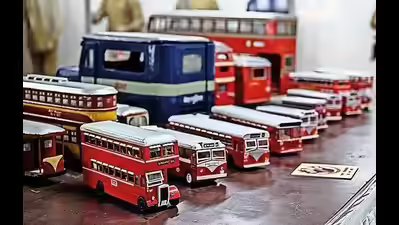
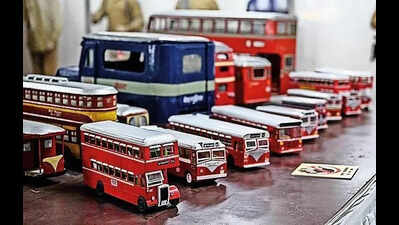
“Why is the BEST bus red?” kids often ask Yatin Pimpale. “Just as local trains are the arteries of the city, BEST buses are its blood vessels,” comes the reply.Tucked away on the third floor of an elevator-less building in Wadala’s Anik depot, the BEST museum charts how Mumbai ended up with one of the “best” bus networks in the world.Pimpale, who retired in Feb this year after nearly four decades of service, was the engine of this remote museum for most of that journey — answering its still-functioning landline, guiding visitors and finishing tours by whipping out his visiting card: a collage of paper BEST bus models he’d fashioned himself.When we met him last summer, the lanky former curator was still in the driver’s seat, rising from beneath the long blades of a 150-year-old fan to walk us through a century of red buses and reversible backrests.Born in the 1980s from a deluge of BEST memorabilia that ended up in a storeroom in Dharavi, the museum, he said, began life as a warehouse in Kurla.“Marathi author SN Pendsay was authoring a book called The BEST Story and the artefacts had been sent in by employees and the public to aid his research,” recalls Pimpale about the miniature models, figures, postcards and tickets later moved to the more spacious Anik Bus Depot in 1993.The man behind this shift was Pandurang Paranjpe, the khaki-shorts-wearing, Gandhi-cap-sporting BEST liaison officer known for showcasing old bus slides on his home projector.On the day we visited, Pimpale guided us — alongside visitors barely waist-high — through Mumbai’s transport history. When he flicked a switch, a tram drawn by two wooden horses chugged across a table, transporting Gen Alpha back to the early 1900s.“The Bombay Tramway Company was formally set up in 1873. By May 1874, the first horse-drawn tram ran from Colaba to Pydhonie. The initial fare was three annas and no tickets were issued,” he said.Despite resistance from bullock cart and victoria drivers, trams gained popularity. Fares dropped to two annas; tickets were introduced later to curb ticketless travel.In 1904, BEST acquired a licence to supply electricity. Pimpale flipped the wooden passenger seats of electric trams to demonstrate how conductors would reverse the backrests 180 degrees for return journeys. “Trams didn’t turn, only the backrests did.”When motor bus services launched in 1926, the economics required persuasion. “Since bus tickets cost more than tram fares, conductors would stand outside holding placards urging people to take the bus,” he recalled.Electric buses, Pimpale noted, aren’t a modern novelty. “Today’s models use lithium batteries, but the first electric bus — the SKODA trolley bus — used positive and negative currents, operating from Gowalia Tank to Mazgaon between 1962 and 1971.”The 8,300-square-foot museum offers something for everyone. While kids scramble aboard the 90-year-old chassis of Mumbai’s first double-decker diesel bus for selfies, adults are drawn to trivia — actor Johnny Walker was a BEST conductor earning Rs 40 a month in the 1940s; Sunil Dutt, Hasrat Jaipuri, Prashant Damle, Sharad Ponkshe, Avinash Narkar and Arun Nalavade also have BEST chapters in their biographies. In the heyday of single screens, long before app-based taxis, BEST even ran dedicated “Cinema Special” buses connecting railway stations — Churchgate, Bombay Central — with iconic theatres like Regal, Eros, Metro and Liberty. The buses waited outside the halls and ferried audiences home after the show. A 1960s BEST timetable in the museum’s collection is among the rarer finds that bring this era to life. “Those early tickets sometimes doubled as advertisement hoardings for new film releases,” said curator Ambadas Garje.Another extinct transport species is the “coupled bus” — a motorised bus towing a non-motorised one, discontinued in 1966 — and the “semi-articulated trailer bus” that operated from 1967 to 1986. Also featured is the now-defunct BEST printing press’s collection of tickets and coupons.Post-1947, ambitions grew faster than approvals. Unfulfilled schemes included overhead rails and a metro, for which engineers were sent to Japan in 1956 and 1962. “Our former deputy general manager P G Patankar went to Berlin and Milan to study the underground railway system,” said Pimpale — today’s Metro Aqua Line 3 runs almost parallel to Patankar’s plan.As the new curator, Garje, who was still Pimpale’s assistant when we visited, now fields the same questions — in Marathi, Hindi or English. He unleashes his own trivia: bus 9 winds past schools from Colaba to Antop Hill; route 166 once linked government hospitals. Many visitors, Garje said, head straight for the currency cabinets — coins and notes from around the world that fell from tourist wallets over the decades, routed through lost and found before landing here.Halfway through our tour, the lights went out, leaving the Brihanmumbai Electric Supply and Transport staff red-faced. When power returned, the cabinets glowed again and the ancient fan above Pimpale’s desk began to whirl.While the museum plans to mark the centenary with a special commemorative exhibition where it hopes to also sell a few rare tickets, bus enthusiasts in the city have already secured their spot in the celebrations. On July 15, Pimpale, one among them, will be riding the special week-long heritage bus that will ply the original route from Afghan Church to Crawford Market. Ticket cost? “Three annas.”(The BEST Transport Museum, 3rd Floor, Anik Bus Depot, Wadala. Monday 7 am–3.30 pm; Tuesday–Sunday 7 am–5 pm. Closed on public holidays. Entry free. Call 7208971177 before visiting for a guided tour.)