











NEW DELHI: From gaming marathons to back-to-back OTT episodes, hours spent glued to a screen may be doing more than straining the eyes and back. Vascular experts warn that prolonged, uninterrupted sitting can slow blood flow in the legs and increase the risk of potentially dangerous blood clots, including deep vein thrombosis (DVT), even among younger people.At a conference being held in the city from Oct 8 to 10, experts said the concern was not gaming or OTT viewing itself, but the prolonged immobility that can accompany them.
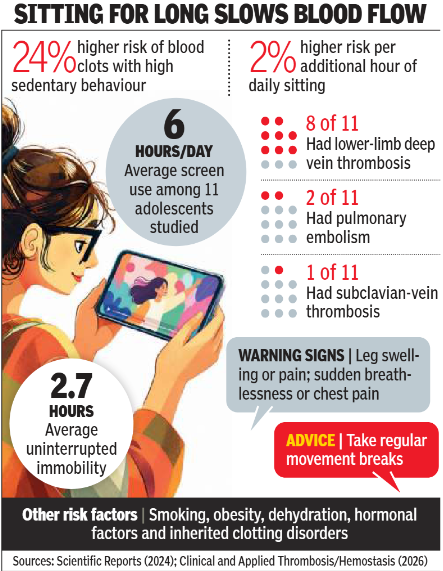
Sitting for long slows blood flow
Dr Tapish Sahu, organising secretary of VSI-ASVS 2026 and head of vascular and endovascular surgery at Max Hospital, said doctors were seeing young patients with prolonged sitting and excessive screen exposure. “Sitting continuously for four to six hours while gaming or binge-watching leaves the calf muscles largely inactive. Movement breaks must become part of digital life,” he said.A 2024 meta-analysis in Scientific Reports, analysing 31 studies, found that people with the highest sedentary behaviour had a 24% higher risk of venous thromboembolism (VTE) than those with the lowest levels. Risk rose by about 2% for every additional hour of daily sedentary behaviour.Dr Tarun Grover, senior director of peripheral vascular and endovascular sciences at Medanta, said immobility had traditionally been discussed in the context of long-distance travel, hospitalisation or being bedridden. “Today, we also need to ask young patients how many hours they spend continuously sitting in front of a gaming console, computer or OTT screen,” he added.Experts cautioned that screen use does not automatically cause DVT, but prolonged sitting may add to the risk when combined with obesity, dehydration, smoking, hormonal factors, inherited clotting disorders or a previous history of thrombosis.A study published this year involving 11 adolescents with thrombosis found that they used digital devices for an average of six hours daily, with uninterrupted immobility averaging 2.7 hours. Eight had lower-limb DVT, two pulmonary embolism and one subclavian-vein thrombosis. Many also had inherited thrombophilia, suggesting that prolonged screen-related immobility may be an additional risk factor rather than the sole cause.Walking activates the calf muscles, which help pump blood towards the heart.Dr Bhupesh Garg, senior vascular and endovascular surgeon at the Vascular Society of India, said that “smoking adversely affects vascular health and increases thrombosis risk, while prolonged sitting slows blood flow from the legs due to calf muscle inactivity”.The experts also stressed that regular exercise may not fully offset the risks of prolonged sitting. For young people, hours in classrooms followed by gaming, streaming or social media can add to their daily sedentary time.DVT occurs when a clot forms in a deep vein, usually in the leg. If it travels to the lungs, it can cause a potentially fatal pulmonary embolism. Swelling, pain or tenderness in one leg warrants medical evaluation, while sudden breathlessness, chest pain or coughing up blood requires urgent medical attention.