








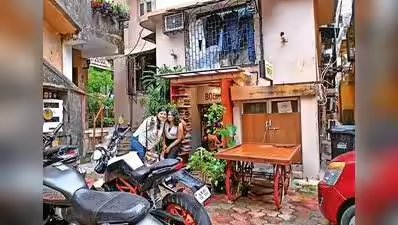
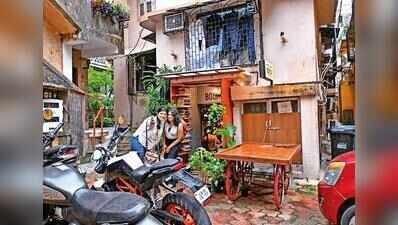
Mumbai: Charles Correa once said, “People don’t come to cities for housing, they come for jobs.” People come to Bandra’s gaothans to escape the city — and for its houses. Here, they make themselves at home in postcard cottages, settling on century-old verandahs to watch village life unspool. It’s a life few can own, but many can briefly have for the price of a coffee and a complimentary madeleine.That’s what the cafes, bookshops, B&Bs and concept stores in Bandra’s gaothans are serving up. In a city caught in the chokehold of concrete, the rustic charm of a rosewood cottage down a flagstone alley flanked by hibiscus in full bloom is a breath of fresh air.Book Bar, far from the madding crowds, has started drawing a crowd of its own. Housed in a low-rise building in the heart of Pali Village, this semi-basement cafe is plastered in paperbacks. “We looked across Bandra, Khar, Versova — until we chanced on this,” says co-founder Avneesh Gadgil. One of four Book Bar cafes — the others are in Pune — it opened in May, removed from the chaos of Ambedkar Road and 16th Road on either side. Gadgil likens the contrast to a cassette: “Everyone experiences Side A of the city, the noise and mayhem; but Bombay also has a Side B — places for pause.”On the adjacent street, Neil Pereira is less charmed. “Pali Village is categorised as a residential zone. How can commercial establishments be allowed here?” demands the longtime resident — though Book Bar, it should be noted, stepped into a former AC repair shop and simply inherited its commercial licence. The concern runs deeper than zoning. “There’s a risk of fire from circuit overload, owing to the high demand for electricity for lighting, cooking and cooling,” says Pereira, founder of the Pali Gaothan East Indian Association. Fire safety norms for commercial establishments in gaothans already forbid flame-cooking, but the risk of electrical overload in these densely wired old buildings is real.Fire is only one worry. S Gonsalves, another Pali Village resident, flags water. “The increased demand from restaurants, offices and studios has affected domestic supply. Their illegal high-horsepower pumps draw water before our tanks can fill up.” Sewage is another pressure point: “The gaothan’s drains were not built for the extra footfall,” says Pereira. “Sewage lines have overflowed in some places.” Heat envelopes from multiple AC units, strangers in the lanes for selfies, security concerns — the list is long.Shormishtha Mukherjee, author of Pudding: The Memory Keepers of Bandra, recalls residents telling her they’ve taken to closing their doors and windows, when once these were gateways to niceties and news. “The changing character of the gaothans has intensified in the last 3-4 years, and it’s visible on its walls. Chapel Road, which once had graffiti, now has ad graffiti.”The question, she asks, is — what are commercial spaces doing for the community? Do they become part of it? Do they ask their customers to be mindful of the neighbourhood?Some do. Chuim 66, a micro-restaurant dishing out pot pies and craft coffee, has signage reminding customers they’re in a residential neighbourhood. “We refitted our chimney when a neighbour complained of the exhaust,” says co-founder Vidit Aren. “We ran the ducting through the centre of the building instead of the exterior to reduce noise. We hope to be here for years and want to coexist with the community.” Book Bar halted interior work for an hour each afternoon to accommodate a neighbour’s nap. “We request customers not to smoke outside and keep the music low,” says Gadgil. “We even hosted an inauguration party for the villagers.”Commerce and community can be combative bedfellows initially, but they can learn to make peace. The sooner the better, because incoming traffic in the gaothans is only going to intensify, warns Shaan Shaikh, a real estate broker. “Enquiries for gaothans have multiplied in the last 3-4 years. I currently have 10 clients looking for cafe space, mostly in Chapel Road and Pali Village. A 250 sq ft cafe rental can cost Rs 1.5-2 lakh at either place,” Shaikh says. “The asking price for a 2,460 sqft, ground+2 bungalow off Carter Road is Rs 5 lakh.” But even at those rates, gaothan cafes are paying nearly 30% less than high-street rents. For homeowners — particularly elderly couples with limited income — the offers are a windfall and a saving grace.Gaothans receive no renovation or maintenance funds from govt. “I spend Rs 3-4 lakh on maintenance every couple of years,” says Clarence Gomes, 75, founder-editor of Bandra Times. “Our 150-year-old house on Bazar Road needs a new balcony, but we’ve been quoted Rs 5-6 lakh just to replace the Burma teak one.”“The question is how to negotiate change while preserving the integrity of the gaothan,” says conservation architect David Cardoz. “Anything that keeps the place going at the same scale without gutting it is fine — unlike redevelopment, which does exactly that.”Residents, architects, and urban planners have long demanded special development control regulations and a policy for gaothans. “In their absence, it’s the community that has conserved them,” says Pankaj Joshi, principal director, Urban Centre Mumbai. He believes communities should link arms with their new commercial neighbours and with civic officials to resolve tensions — and points to European cities developing soft bylaws for residential heritage precincts: noise restrictions at certain hours, rules on lighting and congregation. Mumbai has no such framework yet.“We wanted to establish a low-key neighbourhood space that was accessible,” says Aren, “and the gaothans were the only area that made financial sense. Anywhere else in Bandra and it would have been a heavier ship to run.”