









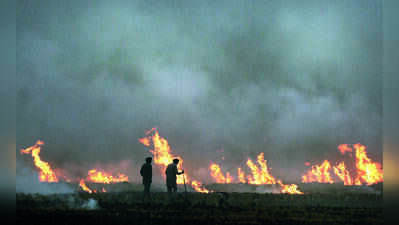
Gurgaon: Haryana has identified 148 villages as potential stubble-burning hotspots for the 2026 paddy harvesting season, based on last year’s farm-fire record, as harvesting gets underway across the state.Of these, three villages have been placed in the red zone and 145 in the yellow zone, while 6,748 villages have been classified as green.The classification is based on active fire location (AFL) data from ICAR for 2025: villages with six or more farm-fire events are classified red, those with two to five events yellow, and those with zero or one event green.The numbers suggest the state’s stubble-burning problem is increasingly concentrated in a small number of villages. In 2024, there were 14 red-zone and 273 yellow-zone villages; both categories shrank sharply in 2025, to three and 145 respectively, while green-zone villages rose from 6,617 to 6,748.The three red-zone villages are spread across Hisar, Jind and Kaithal. Among yellow-zone villages, Jind has the highest count at 48, followed by Fatehabad (21), Kaithal (16), Sonipat (16), Rohtak (14) and Hisar (11).The classification underpins the state’s shift to a village-level strategy, targeting additional resources at hotspot villages rather than treating all paddy-growing areas alike. Machinery requirements will be assessed through micro-level planning, with village-level nodal officers and block- and district-level control rooms tasked with monitoring fires and coordinating residue-management equipment. Each nodal officer will be assigned 100 farmers, while senior officers will be deployed in hotspot districts; the state also plans to set up a dedicated ‘Parali Protection Force’ at district and block levels.Every farm in the identified villages is to be mapped for its proposed residue-management method — in-situ management, ex-situ management, crop diversification, or use as fodder.“Satellite monitoring will be integrated with field enforcement. AFL alerts will be sent to field officers through SMS and WhatsApp, allowing reported fires to be followed up on the ground,” said Vijayendra Kumar, additional chief secretary, agriculture and farmers welfare department, Haryana. Nodal officers will also be responsible for ensuring environment compensation is imposed and recovered in cases identified through the satellite-based protocol.Enforcement remains stringent: farmers found burning residue face environment compensation of Rs 5,000 for fires on less than two acres, Rs 10,000 for two to five acres, and Rs 30,000 for more than five acres. FIRs can also be lodged, a red entry made in the farmer’s records, and violators barred from selling produce in mandis for the next two seasons.The state has also built in an incentive: panchayats that move from the red or yellow category to green will be awarded at the end of the 2026-27 financial year.The strategy marks a shift from simply counting farm fires at the district level to using the previous season’s fire history to decide where manpower, machinery and monitoring should be concentrated this season — while the large number of green-zone villages signals the govt’s intent to preserve the classification as a measure of village-level performance rather than treat every paddy-growing village as a hotspot.Awareness programmes are planned at the state, district, block and village-panchayat levels, along with training for farmers, unemployed youth and custom hiring centre owners. Hoardings, posters, wall paintings and digital screens will be installed, particularly in hotspot villages and other high-footfall locations.