








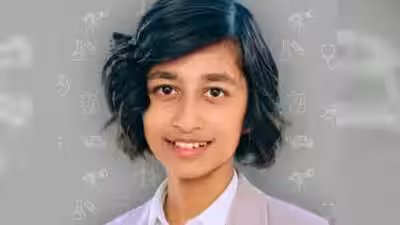
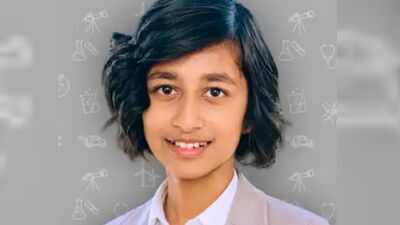
A 13-year-old Indian-American student from Minnesota has invented a method to reduce pesticide residues on fresh fruits and vegetables by using peanut shells, something that is usually thrown away.Arika Kundu, a seventh-grade student at Minnetonka Middle School East in Shorewood, Minnesota, developed the method. Her project is called ‘LIGNEX – A novel biosorption based approach that uses agricultural waste material to eliminate pesticide residues from fresh produce’.The project has also earned her a place among the 10 finalists in the 2026 3M Young Scientist Challenge. The national competition recognises middle school students aged 11 to 14 who develop science-based solutions for real-world problems.As a finalist, Arika will now work with a 3M scientist over the summer before competing in the final round in October, where she will have the chance to win the $25,000 grand prize and the title ‘America’s Top Young Scientist’.
Idea of using peanut shells
Fruits and vegetables can carry pesticide residues on their surface after they are harvested. Washing produce helps remove dirt and some chemicals, but it may not remove everything. Arika wanted to find a practical and affordable way to reduce those residues further.Instead of using expensive materials, she looked at agricultural waste. Peanut shells are usually discarded after the nuts are processed. She designed a method that converts these shells into a material capable of trapping pesticide residues from the surface of fresh produce.Her project uses a scientific process known as biosorption. Because peanut shells are an agricultural waste product, her idea also gives a second use to material that would otherwise be thrown away.Some natural materials can attract and hold certain chemicals, much like a sponge absorbs water. In Arika’s project, the treated peanut-shell material acts like a natural filter.When fresh produce comes into contact with it, the material captures pesticide residues from the surface. This could help reduce the amount of pesticides left on fruits and vegetables.
The 3M Young Scientist Challenge
The 3M Young Scientist Challenge, organised by 3M and Discovery Education, is now in its 19th year. The competition invites students in grades five to eight to develop science-based solutions for everyday problems.This year, 10 finalists from across the United States were selected after submitting one- to two-minute videos explaining their ideas. Judges evaluated the entries based on creativity, scientific knowledge and communication skills.Over the summer, each finalist will work one-on-one with a 3M scientist to improve their project. The competition will conclude on October 12 and 13 at the 3M Innovation Center in St. Paul, Minnesota, where finalists will complete live challenges, present their projects and answer questions from judges.Arika said she entered the competition because she wanted to improve her innovation and eventually make it useful for everyone. “I entered the 3M Young Scientists Challenge to improve my innovation and turn it into a product that everyone can benefit from,” she said, as quoted by Young Scientist Lab.Arika also said she won the Minnesota State Merit Award last year and hopes becoming a national finalist will help her receive expert advice from 3M scientistsArika also has clear plans for the future. “In 15 years, I hope to be an astrobiologist, specifically in computational biology,” she said.She said she wants to work on reducing radiation exposure during space travel. According to Arika, solving this challenge could not only support future space missions but also contribute to research related to cancer treatment, ageing, degenerative diseases and agriculture.Brian Shaw, Chief Executive Officer of Discovery Education, says the finalists showed that scientific curiosity has no age limit. “The finalists of this year’s 3M Young Scientist Challenge prove you can be a scientist at any age,” Shaw said.” Each remarkable student pursued their curiosity with persistence, turning an idea into an innovation. We cannot wait to see where their ideas take them,” Shaw said according to an official statement.Over the years, previous finalists have created projects on topics such as food safety, water conservation, air pollution, energy use and cybersecurity. Some have later filed patents, delivered TED Talks and started nonprofit organisations.