



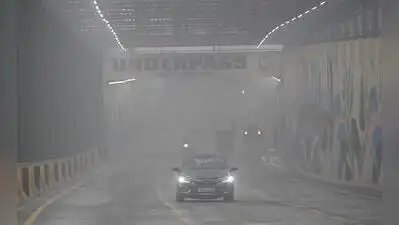
Noida: Sunshine and increased wind speed failed to disperse pollutants as the city continued to see dense smog. The city’s average AQI did not see any improvement and was recorded at 297 (poor) at 4 pm on Saturday, nearly the same as 303 (‘very poor’) recorded a day ago. With firecrackers being burst throughout the day and intensifying from late evening, pollution levels remained high, pushing the average AQI back to ‘very poor’ at 307 at 8pm.The Sector 62 air monitoring station recorded the highest AQI at 410, placing it in the ‘severe’ category. Sector 39 recorded an average of 301 (‘very poor’) and the remaining stations recorded average AQIs in the ‘poor’ category.Greater Noida recorded an average AQI of 281 (‘poor’), improving from 316 (‘very poor’) on Friday. Shiv Nadar University recorded the highest reading at 293, followed by Knowledge Park-V at 291, Ghodi Bachheda at 281 and Knowledge Park-III at 259. No reading was available for Gaur Yamuna City.Ghaziabad’s average AQI stood at 277 (‘poor’), compared with 257 on Friday. Loni recorded the highest reading at 322 (very poor), followed by Wave City at 316. Sanjay Nagar and Indirapuram recorded 294 and 292, respectively. New Tehsil-Loni stood at 270, while Ved Vihar-Loni and Govindpuram reported relatively lower readings of 227 and 216. No reading was available for Vasundhara.Delhi’s and Gurgaon’s air remained in the ‘very poor’ category. The average AQIs recorded there were 369 and 345, respectively.Central Pollution Control Board’s data shows that on the day before Diwali, Delhi recorded an AQI of 296 (Oct 19) in 2025, 307 (Oct 30) in 2024, 220 (Nov 11) in 2023, 259 (Oct 23) in 2022, 314 (Nov 3) in 2021, 339 (Nov 13) in 2020, 287 (Oct 26) in 2019, 338 (Nov 6) in 2018 and 302 (Oct 18) in 2017. CPCB started measuring AQI in 2015.Experts said AQI is likely to worsen to the severe range (above 400 on a scale of 500) due to high emissions from local and regional sources, additional emissions from firecrackers and stubble burning, and adverse weather conditions, including calm winds.The Supreme Court has allowed only bursting of green crackers on Nov 7 and 8 during two slots: 6 am to 7 am and 8 pm to 10 pm. However, TOI reported that the city markets are flooded with conventional firecrackers with fake green labels. Residents complained that the ban was flouted Saturday in parts of Delhi-NCR.“In all likelihood, Nov 9 could emerge as the most polluted post-Diwali day in several years. Meteorological conditions appear highly conducive to severe pollution, with winds at the transport level — where stubble burning smoke travels — expected to be north-northwesterly, favouring the transport of smoke from the peak burning areas of Punjab and Haryana towards Delhi,” said Gufran Beig, the founder of System of Air Quality and Weather Forecasting and Research (SAFAR) and Chair Professor at National Institute of Advanced Studies (NIAS).Beig said that with firecrackers, including so-called green crackers that generate around 70% lower emissions than conventional ones, likely to be burned openly without restrictions, the combined emissions could further aggravate the situation.But he has his fingers crossed. Though chances are slim, an unusual and uncertain shift in the anticipated Super El Nino-driven weather pattern, resulting in stronger local winds, may offer some respite and prevent the severity of this anticipated pollution episode, he said.TOI reported that AQI rises significantly the day after the festival. In 2025, the AQI on the day before Diwali (Oct 19) was 296 in the poor range, but it rose to 345 in the very poor category on Diwali day (Oct 20) and further to 351 on the day after Diwali (Oct 21). While the use of green crackers was allowed for two hours in the night on two days, the ban was widely flouted. Since the festival was celebrated in mid-Oct, the impact of winter conditions and stubble burning was less. A similar pattern was seen during Diwali 2024.Several stations saw severe air quality levels Saturday, with IIT-Delhi (452) the most polluted at 4 pm. It was followed by Punjabi Bagh (439) and Jahangirpuri (428). Other areas which recorded hazardous levels of pollution included Mundka (426), Vivek Vihar (426), Rohini (424), RK Puram (420), Bawana (420), Sonia Vihar (417), Siri Fort (415), DTU (416), Narela (416), Najafgarh (413), Dwarka-Sector 8 (411), Alipur (410), Pusa (408), Dr Karni Singh Shooting Range (407), Jawaharlal Nehru Stadium (403) and ITO (402).