










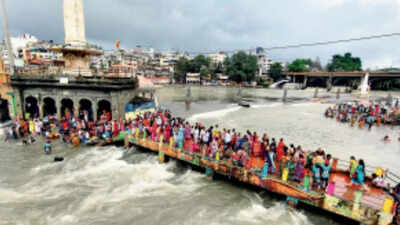
PUNE: Every 12 years, when celestial alignments and centuries-old traditions converge, Nashik becomes the stage for an extraordinary act of faith.The ghats of the Godavari fill with saffron robes, sacred chants and millions of pilgrims seeking spiritual merit at the Simhastha Kumbh Mela.As the Dhwajarohan on Friday sets the sacred wheel in motion once again, the city stands at the threshold of an event that promises not only faith, ritual and renewal, but also a transformation of Nashik and Trimbakeshwar on a grand scale.

Devendra Fadnavis, CM, Maharashtra
For devotees like Dr Harshad Patel, the pull of Nashik’s Kumbh is irresistible. The former president of the Indian Medical Association’s Ahmedabad chapter will visit the mela for the fourth time.His family stays with relatives in Panchavati through the festivities, returning year after year despite hardships and crowds.“My mother suffered a fracture during the 2003 stampede, but she still came back in 2014-15. It is an unmatched spiritual experience,” Patel said. “The arrangements have only improved over the years.”The Kumbh’s hold over people stretches back centuries. Held at only four places in the country where drops of the mythical nectar of immortality are believed to have fallen, Nashik occupies a special place in the tradition.Unlike Prayagraj, Haridwar and Ujjain, the Simhastha unfolds across two locations, Nashik and Trimbakeshwar, a unique legacy born from rivalry.After fierce clashes between Shaiva and Vaishnava sects at Trimbakeshwar in 1838 over ritual precedence, the authorities separated the akhadas.Shaiva seers continued at Kushawarta in Trimbakeshwar, while Vaishnava akhadas shifted to Ramkund and Tapovan in Nashik.

Once in 12 years mega spiritual gathering (Photo credit: Pankaj Chandole)
The arrangement survives to this day, giving the Nashik-Trimbakeshwar Kumbh its distinctive character.The timing, too, is unique.The Nashik-Trimbakeshwar Kumbh is held when Jupiter enters Leo, and the Sun enters Aries, a celestial alignment that gives the gathering its name, Simhastha. The celestial alignment is believed to infuse the Godavari with immense spiritual potency.While the three Amrit Snans draw the largest crowds, devotees also flock to Nashik on 45 auspicious bathing dates and to Trimbakeshwar on 29 others.With the Dhwajarohan on Oct 31, Nashik formally enters the Simhastha cycle, leading up to the three sacred Amrit Snans on Aug 2 and 31, and Sept 11, 2027.Backed by an investment of Rs 34,732 crore, the 2027 Simhastha is becoming far more than a religious congregation. It is emerging as the biggest public infrastructure push in north Maharashtra’s history.More than 350 projects are under way.Nearly 85% are permanent assets designed to serve the region for decades after the last pilgrim leaves. Roads, bridges, sewerage networks, riverfronts, ghats, transport links and heritage precincts are all being upgraded.Kumbh Mela minister Girish Mahajan said the investment is 10 times more than that made for the previous edition.“Last time, the Kumbh concluded peacefully and without any casualties. We want to build on that legacy and deliver a clean, safe and well-managed Kumbh in 2027,” he said.The largest share of the investment is going into mobility.Nearly 150 kilometres of roads are being widened and upgraded. Eight new bridges over Godavari and its tributaries are planned to ease movement during peak pilgrim days. The proposed 65.6km Nashik Outer Ring Road, estimated at Rs 7,613 crore, is expected to permanently reshape the city’s traffic flow.The pilgrimage landscape itself is also changing. New ghats stretching over 3.4 km are being built along Godavari in Nashik.Additional bathing ghats are planned at Trimbakeshwar. Historic temples and kunds are being restored. The ambitious Shiv Darshan Path project aims to transform the temple town into a world-class pilgrimage destination.Perhaps the most important investment is happening beneath the surface.Making Godavari fit for millions of ritual baths has triggered Nashik’s biggest-ever sewerage overhaul. Four modern sewage treatment plants and nearly 200km of sewer lines are being built to stop untreated wastewater from entering the river.Nashik municipal commissioner Manisha Khatri said more than half the work is already complete and the project will be finished before the Kumbh.The challenge is formidable.A weak monsoon has pushed much of Maharashtra into drought, making water management one of the most closely watched aspects of the festival. Yet officials remain confident that both the needs of pilgrims and those of residents can be balanced.For many, however, the true significance of Simhastha Kumbh lies beyond numbers and engineering. It lies in the faith that keeps drawing people back.For Patel and countless others, Nashik’s Kumbh is a rare moment when generations travel together, ancient traditions come alive, and spirituality takes over an entire landscape.“The infrastructure being created today will serve Nashik, Trimbakeshwar and the district for at least the next 30 years,“ says Nashik-Trimbakeshwar Kumbh Mela Authority commissioner Shekhar Singh.“These facilities will strengthen tourism, improve connectivity and help establish Nashik as a global destination long after the Kumbh Mela concludes,” the commissioner added.