








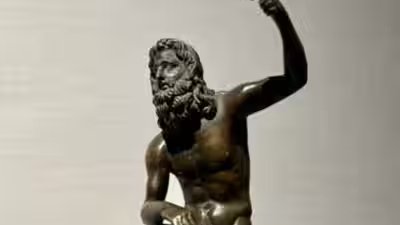
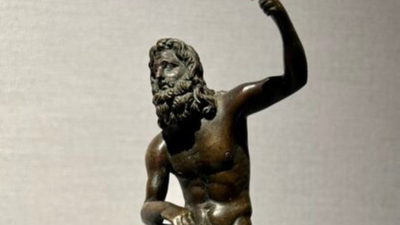
PUNE: A 14-cm bronze statuette of Poseidon in Kolhapur is offering a glimpse into the city’s ancient links with the Greco-Roman world and has drawn renewed attention with Greek mythology back in the spotlight following the release of Christopher Nolan’s “The Odyssey” earlier this year.Discovered at the Brahmapuri mound along the Panchganga river in the 1940s, the more than 2,200-year-old artefact is believed to be among the finest evidence of the maritime and commercial exchanges that connected western India with the Roman world.Poseidon, the Greek god of the sea and a central figure in the world of “The Odyssey”, is now on display at Mumbai’s Chhatrapati Shivaji Maharaj Vastu Sangrahalay, while a replica remains at Kolhapur’s Town Hall Museum.The mound was first explored in 1877. Digging revealed brick ruins of a Buddhist monastery and a stone relic coffer with two compartments with one side holding Buddha’s relics in a casket. The inscriptions were in Brahmi and the place was named Brahmapuri.In 1945, director of Kolhapur state archaeology department K G Kundangar found the Poseidon statuette and other bronzes at a depth of three meters.The princely state then roped in archaeologist H D Sankalia, who had just discovered the first stone-age skeleton of Mesolithic period at Langhnaj in Mehsana district of Gujarat. Three scholars from Dharwar, and four each from Kolhapur and Pune also participated in the Brahmpauri excavation.
Fans now explore links
Lahu Kamble, who has visited the museum many times, described the film as a double treat. Long before he became an admirer of filmmaker Nolan, Kamble had developed an interest in ancient mythologies, from Greek legends and Indian epics to the mysteries of Egyptian civilisation and archaeology.“The movie sparked my curiosity about India’s ancient trade links with the Greco-Roman world. Archaeological discoveries always have a story to tell,” he said.Vedant Bagal, a second-year MBBS student at Government Medical College in Miraj, went to a multiplex in Kolhapur to watch the film with two classmates.“Like every Nolan movie, ‘The Odyssey’ leaves you fascinated by its subject. We are now keen to visit the museum and learn more about Greek gods and myths, especially the deity whose actions make Odysseus’s journey longer and far more challenging.”
How did it get to Kolhapur?
The description in a catalogue of ‘Networks Of The Past’ said shipwrecks were a constant threat to the Indo-Roman ocean trade and sailors carried amulets and figurines of the sea god Neptune (Poseidon in Roman) as a thanksgiving offering. The Kolhapur bronze could be one of them, it added.Eminent archaeologist V S Shinde said the Brahmapuri finds were unique and rich and a strong validation of Roman trade with India.“Romans and Greeks knew how prosperous India was even before Alexander’s arrival and trade was vigorous. Nane Ghat and other ghats connecting Karad and Kolhapur were trade routes,” he added.Ancient Greco-Roman geographical texts identify Kolhapur as Hippokoura or Hippokura which appears in Ptolemy’s Geographia.In his accounts of inland, Ptolemy lists Hippokoura as the inland capital or royal residence of Baleokouros who modern historians identify as Satavahana ruler Vashishtiputra Vilivayakura.Hippo is a Greek adaptation of the local Prakrit/Sanskrit name associated with horse trading or military posts along the trade routes of Western Ghats.The first-century CE Greco-Roman maritime logbook ‘Periplus of the Erythrean Sea’ said the Indo-Roman trade included ivory, spices and cotton in exchange for gold, silver and precious stones.Shinde said the Poseidon Bronze was probably given by a Roman trader to an affluent local. Other theories say a local seafarer carried the figurine during a journey as a souvenir, some believe that a Roman trader brought it with him as a good omen during his voyage and left it here.Since Roman, Greek and Indian seafarers cohabited Socotra island near Yemen, the statuette may have come back with a seafarer.“Socotra was a halt for all seafarers. People would perform a puja of ‘Socotra Devi’ for safe journey. Inscriptions in Brahmi and Sanskrit and the drawing of a stupa are found in Hoq Cave on the island. Indians were on this island much earlier, in the fifth or sixth century BCE,” Shinde said.