









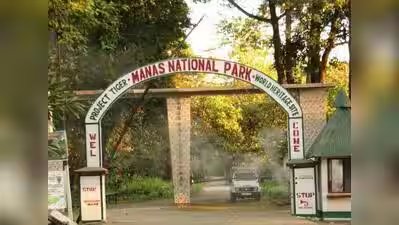
Guwahati: When ‘Mainao’, a rescued rhino calf from Kaziranga, was brought to Manas National Park in 2006, it marked the start of the park’s rhino comeback. Today, Manas has over 50 greater one‑horned rhinos, a thriving population that shows how conservation and community efforts have helped restore what was once lost.The park was stripped of all greater one‑horned rhinos by 1993 due to poaching and conflict. Assam forest minister Jayanta Mallabaruah said the population is breeding and firmly re‑establishing itself in the park’s restored habitat.Mallabaruah said Manas was once estimated to have had between 75 and 100 rhinos before the species disappeared from the park. “Manas National Park once had zero rhinos,” he said, referring to the turnaround achieved through sustained conservation, habitat protection, reintroduction efforts and community participation.According to him, the park has also recorded zero known rhino poaching for three consecutive years. He attributed this to the efforts of the forest department, frontline personnel, conservation partners and local communities.He described the recovery as an example of what could be achieved when conservation, protection and community participation work together.“Manas has gone from zero to hero, and every rhino born here is a symbol of Assam’s promise to protect its wildlife and restore what was once lost,” he said.A key part of Manas’s rhino-recovery programme has been the rehabilitation of orphaned and rescued calves. Initially cared for at the Centre for Wildlife Rehabilitation and Conservation (CWRC) in Kaziranga, suitable calves were later moved to a pre-release boma in Manas, where they were acclimatised to the wild before being released into the park. Some of the rehabilitated rhinos have since bred in the wild, helping to rebuild the population.The rhino reintroduction and rehabilitation programme in Manas began in Feb 2006. The first rhino, Mainao, a flood-rescued calf from Kaziranga that had been hand-raised at the CWRC, was moved to Manas. This marked the beginning of efforts to restore rhinos to a landscape where they had become locally extinct.CM Himanta Biswa Sarma, in a post on X, said Assam was home to 80% of the world’s rhino population and that no poaching case was registered in the state last year.Minister Mallabaruah reaffirmed the state govt’s commitment to protecting the rhinos, one of Assam’s most prominent symbols of natural heritage.“The greater one-horned rhinos is our pride and a treasured part of Assam’s rich biodiversity. Under the leadership of CM Sarma, the state govt has continued to strengthen rhino protection, habitat conservation and anti-poaching efforts,” he said.There are currently 3,260 rhinos in Assam and the state govt has so far destroyed 2,479 rhino horns seized from poachers.The theme for World Rhino Day 2026 is “Keep the Five Alive”, with an associated focus on “building a future for rhinos” to raise awareness on the protection and survival of all five remaining rhino species worldwide.Manas National Park is spread across Assam’s Chirang and Baksa districts and borders Bhutan. Both districts fall within the Bodoland Territorial Region. The park suffered extensive damage because of militancy, poaching, forest encroachment and habitat loss, leading to a sharp decline in wildlife numbers.Manas Wildlife Sanctuary was inscribed on the Unesco World Heritage List in 1985. It was placed on the List of World Heritage in Danger in 1992 and removed from the list in 2011 after Unesco noted the recovery of the site.