








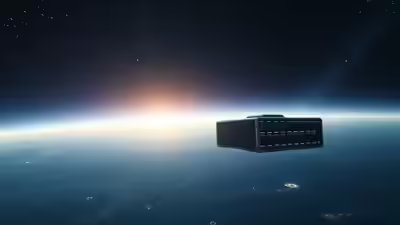
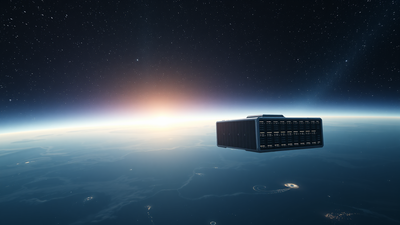
Artificial intelligence is driving an unprecedented surge in demand for computing power. Still, the data centres behind today’s most advanced AI models face a growing challenge: keeping millions of processors cool without consuming vast amounts of energy and water. On Earth, cooling systems can account for a significant share of a facility’s electricity use while requiring millions of litres of water each year. In space, however, the rules are entirely different. There is no atmosphere, no cooling towers and no rivers to absorb excess heat. Instead, engineers rely on large radiator panels that release waste heat directly into space as infrared radiation. This fundamental difference is prompting researchers to explore whether orbital data centres could offer a more sustainable future for AI infrastructure.
Why do cooling data centres on Earth consume so much energy and water
Keeping a data centre cool on Earth is one of the industry’s biggest engineering challenges. Modern servers generate enormous amounts of heat, and without effective cooling, they can quickly overheat, reducing performance and damaging equipment.According to the US Department of Energy, data centres are one of the most energy-intensive building types, consuming 10 to 50 times the energy per floor space of a typical commercial office building. Collectively, these spaces account for approximately 2% of the total U.S. electricity use, and as our country’s use of information technology grows, data centre and server energy use is expected to grow too, depending on the facility’s design, climate and efficiency measures. Many large facilities also consume millions of litres of water each year through evaporative cooling systems, adding pressure to local water resources.In contrast, space eliminates several of these constraints. There is no surrounding air to heat up, no cooling towers to operate and no water required for evaporative cooling.
How do space data centres stay cool without air or water
The absence of an atmosphere means conventional cooling systems cannot operate in orbit. Instead of using fans or water-based cooling towers, spacecraft rely on thermal radiators to manage heat.Electronic components transfer heat to circulating coolant loops, which carry the thermal energy to large radiator panels mounted on the spacecraft. These panels then emit the heat into space as infrared radiation, the only practical way to lose heat in the vacuum of space.“The only escape route is infrared radiation: the spacecraft must literally glow its heat away, at wavelengths so weak it’s invisible to our eyes,” states the World Economic Forum.Because there is virtually no air in space, heat cannot escape through convection. Instead, spacecraft depend almost entirely on thermal radiation to maintain safe operating temperatures.Although this method removes the need for water-intensive cooling infrastructure, radiator systems must be carefully engineered. Their size, orientation and surface coatings directly affect how efficiently they can reject heat while remaining exposed to the cold darkness of space.
Could orbital data centres become the future of AI infrastructure?
As AI models become larger and more computationally demanding, researchers and technology companies are exploring whether placing data centres in orbit could reduce pressure on Earth’s electricity grids and freshwater supplies.While space-based facilities could eliminate evaporative cooling and benefit from continuous solar power in suitable orbits, they also introduce significant engineering challenges. Launch costs remain high, hardware maintenance is extremely difficult, and every watt of computing power ultimately becomes waste heat that must still be dissipated through radiators.WEF agrees that by moving the most energy- and water-intensive parts of AI computation beyond Earth’s atmosphere, we turn an existential challenge, energy demand, into a profound opportunity for decarbonization, resilience and a truly sustainable digital future.For now, orbital data centres remain an emerging concept rather than a commercial reality. However, advances in reusable launch systems, satellite manufacturing and space infrastructure are making the idea increasingly plausible. If these technical hurdles can be overcome, space could eventually provide an alternative location for some of the world’s most energy-intensive computing workloads.
Why cooling becomes more difficult as AI data centres grow
The rapid expansion of artificial intelligence is reshaping how data centres are designed and operated. Training and running advanced AI models require thousands of high-performance processors working simultaneously, each producing substantial amounts of heat. As computing density increases, conventional air-cooling systems become less effective, prompting operators to adopt more advanced liquid-cooling technologies that improve heat transfer but can also increase demand for water and supporting infrastructure.The International Energy Agency (IEA) estimates that electricity consumption from data centres is set to rise significantly over the coming years, driven largely by AI workloads. “Electricity consumption from data centres is set to double by 2030, and power use from those focused on AI is poised to triple,” states the IEA.Improving cooling efficiency has therefore become a critical priority, not only to reduce operating costs but also to ease pressure on electricity grids and freshwater resources. This has led to increasing interest in finding alternatives that include the hosting of computing resources in areas where thermal issues can be better controlled.
What difficulties do space-based data centres have to overcome
Although there are many benefits of such an approach, orbital data centres still need to clear quite a few technical and financial barriers before they can become feasible options. All parts will have to withstand the extreme environment in space, which will include heavy radiation, temperature changes, as well as the danger of being hit by micrometeoroids and other debris. Since there is no chance of replacement on site by engineers, everything has to be highly reliable, and robotic maintenance, where possible.Communication is another issue. While satellites can provide quick information exchange, it is not yet clear whether it is suitable for applications that require an immediate response. Launching thousands of tons of computers into space is also too costly at the moment. According to NASA, successful long-duration spacecraft also require sophisticated thermal control, power management and fault-tolerant systems, all of which add complexity to operating large-scale computing infrastructure beyond Earth.