








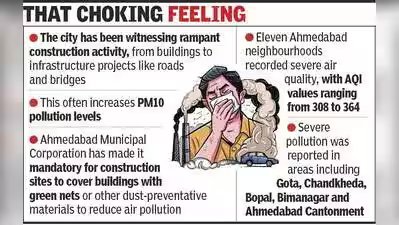
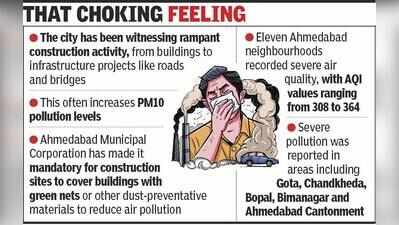
Ahmedabad: The city skyline has worn a layer of haze of late, as air quality deteriorated in several pockets, well before peak winter. Even as minimum temperatures hover between 25°C and 26°C and maximums around 37°C, the city is experiencing elevated pollution, with PM10 particulate matter identified as the primary pollutant.The Central Pollution Control Board’s (CPCB) data puts Ahmedabad’s average Air Quality Index (AQI) at 252 around 10pm Sunday. But the citywide average masked higher readings in individual areas.According to the aqi.in website, Ahmedabad’s real-time air quality data of 11 locations showed “severe” air pollution.Overall, the city registers around 10pm a live AQI of 276 (unhealthy), with average PM2.5 pollution (from dust particles of 2.5 microns) of 121 micrograms per cubic metre (µg/m³) and PM10 (particulate matter measuring up to 10 micrometres) at 163 µg/m³.Gyaspur recorded the city’s highest PM10 level at 189 µg/m³ (AQI 314), closely followed by Aam Baag on Adalaj-Koba Highway (185.39 µg/m³), and Applewoods Township Main Road (182.84 µg/m³), around 9:45pm on Sunday.Bavla stands out as the only location in the ‘moderate’ category, recording an AQI of 83, PM2.5 of 50 µg/m³, and PM10 of 65 µg/m³ .PM2.5 levels fluctuated between 52 µg/m³ at 4:01pm and 126 µg/m³ at 9:31pm on Sunday.Air quality in the city deteriorated overnight to reach a morning peak of approximately 122 µg/m³ at 10:01am, likely driven by morning traffic and atmospheric inversion.Increased atmospheric mixing during the warmer afternoon brought levels down to the 24-hour minimum of 52 µg/m³ at 4:01pm, before evening traffic and cooling air trapped pollutants, sending PM2.5 surging to its 24-hour peak.Eleven Ahmedabad neighbourhoods recorded severe air quality, with AQI values ranging from 308 to 364. Severe pollution was reported in areas including Gota, Chandkheda, Bopal, Bimanagar, and Ahmedabad Cantonment.PM10 is commonly associated with road dust, construction activity, soil, and other sources of coarse particles.“The city has been witnessing rampant construction activity, from buildings to infrastructure projects like roads and bridges,” said Mahesh Pandya, an environmentalist.He added, “This often increases PM10 pollution levels. Construction sites, uncovered building materials, debris, excavation, and the movement of heavy vehicles can all contribute dust to the air.”Pandya said even as AMC has made it mandatory for construction sites to cover buildings with green nets or other dust-preventative materials to reduce air pollution, compliance is the question.“There is a massive decline in urban green cover, which absorbs dust particles, which is why the air quality is suffering even more gravely,” Pandya added.Measures such as covering loose construction material, promptly removing debris, controlling dust during demolition and excavation, and preventing vehicles from carrying mud onto roads can help limit the spread of particulate matter.Colder weather and atmospheric conditions can affect pollutant dispersion.Kamlesh Naik, a senior physician, said that Navratri-related cases have spiked in OPDs across the city.“Dust-related allergic reactions have increased, but a major spike is expected after Navratri festivities,” he said. “Due to mass gatherings, flu cases have also increased, but high-grade fever cases are relatively few.”