








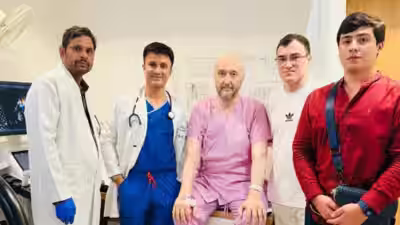
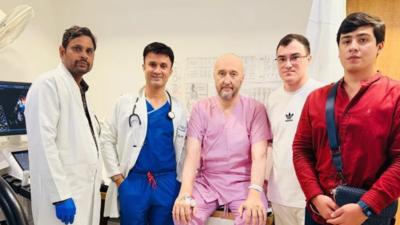
GURGAON: A 62-year-old retired engineer from Uzbekistan, who developed severe heart valve leakage after two open-heart surgeries, underwent a catheter-based valve replacement at a Gurgaon hospital, avoiding a third major operation that doctors considered high-risk given his surgical history and complex cardiac anatomy.The patient, Israilov Jakhongir, was admitted to Paras Health on September 28 with severe breathlessness that left him struggling to walk even a few steps. He also experienced worsening symptoms while lying down and had been repeatedly hospitalised for heart failure.Doctors diagnosed severe recurrent mitral regurgitation, a condition in which the mitral valve fails to close properly, allowing blood to flow backwards and placing additional strain on the heart.Jakhongir had previously undergone two open-heart surgeries for mitral valve disease, including a repair using a 36-mm surgical annuloplasty ring. When the repair failed, another conventional surgery posed substantial risks, prompting doctors to evaluate him for a minimally invasive alternative.The cardiac team performed detailed three-dimensional transesophageal echocardiography and cardiac CT scans to assess the existing surgical ring, valve dimensions and the risks associated with implanting a replacement valve. The doctors then implanted a 33-mm Myval valve within the existing ring through a catheter-based procedure known as transcatheter mitral valve-in-ring replacement (TMVR).The procedure was performed under continuous fluoroscopic and 3D echocardiographic guidance. Doctors had to carefully position the new valve to minimise the risk of obstruction to blood flow from the left ventricle, valve displacement and persistent leakage.Dr Amit Bhushan Sharma, senior director of interventional cardiology at Paras Health, said repeat surgery can present complex challenges for patients who have already undergone two open-heart operations.“In carefully selected high-risk patients, TMVR can offer an alternative to repeat surgery. Detailed imaging and careful procedural planning are essential to assess the anatomy, determine the feasibility of valve implantation and achieve a successful outcome,” he said.Following the procedure, the patient showed a marked reduction in breathlessness. According to the hospital, post-procedure imaging confirmed that the valve was well positioned and functioning effectively, with near-complete elimination of the severe leakage.He was discharged on October 6 and returned to Uzbekistan.The patient said he had travelled to India seeking another treatment option after his condition deteriorated following the earlier surgeries. He said the procedure had given him an opportunity to recover and return to his family without undergoing another open-heart operation.TMVR is a catheter-based approach that allows doctors to replace a diseased mitral valve in selected patients without conventional open-heart surgery. In valve-in-ring procedures, the replacement valve is implanted within a previously placed surgical annuloplasty ring. The suitability of the procedure depends on detailed assessment of the patient’s anatomy and procedural risks.