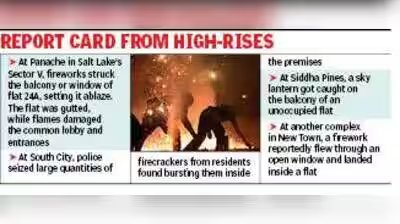







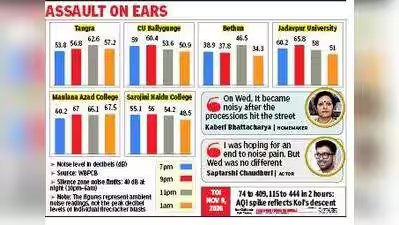
Kolkata: After a relatively quiet Tuesday, the deafening sound of high-decibel firecrackers returned to haunt Kolkata on Wednesday night as immersion processions turned several neighbourhoods into noise hotspots. Firecrackers were burst indiscriminately along immersion routes, leaving residents distressed, patients struggling with the sudden explosions and stray animals scampering for shelter.The noise assault, which began in the evening and continued well past midnight, shattered the brief respite residents had enjoyed after three consecutive nights of firecracker revelry. Despite restrictions on high-decibel crackers and their use beyond permitted hours, immersion revellers appeared largely undeterred.Data recorded by the West Bengal Pollution Control Board’s (WBPCB) noise monitoring stations corroborated residents’ complaints, showing elevated sound levels at several locations late into the night.The sharpest and most persistent noise levels were recorded at Maulana Azad College, where readings climbed from 60.2 decibels (dB) at 7 pm to 67 dB at 9 pm. The level remained high at 66.1 dB at 11 pm before rising further to 67.5 dB at 1 am, indicating that the noise disturbance continued well beyond midnight. The night-time standard for most of these stations is 40 dB.At Tangra, noise levels rose steadily from 53.8 dB at 7 pm to 56.8 dB at 9 pm and peaked at 62.6 dB at 11 pm before declining to 57.2 dB at 1 am. Jadavpur University recorded 65.8 dB at 9 pm, up from 60.2 dB two hours earlier, before readings fell to 58 dB at 11 pm and 51 dB at 1 am.At Calcutta University’s Ballygunge campus, the noise level reached 60.4 dB at 9 pm, while Sarojini Naidu College in Dum Dum recorded 56 dB at the same hour. Bethune College, comparatively quieter during the evening, witnessed a rise from 37.8 dB at 9 pm to 46.5 dB at 11 pm.Environmental activists alleged that enforcement remained inadequate despite repeated complaints from residents.“We received many complaints. My experience is that police looked the other way as revellers kept bursting firecrackers at random,” said Naba Dutta of Sabuj Mancha, an environmental organisation campaigning against noise pollution.Activists pointed out that the prescribed ambient noise limits in residential areas are 45 dB at night, while silence zones have stricter limits of 40 dB.Although the monitoring stations record overall ambient noise rather than firecracker explosions alone, the sustained late-night readings reinforced concerns over the failure to protect citizens from noise pollution during immersion festivities.