









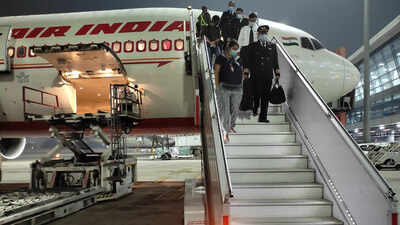
NEW DELHI: Air India has asked its cockpit and cabin crew operating flights between India and North America that take a fuelling halt in Europe since the US-Iran war broke out this Feb, to remain on board till the relief crew takes over from them to operate the remaining lag of the flight. The reason: Refuelling takes place during these halts which requires the cockpit to be manned by pilots and/or engineers for the process and since passengers remain on board during this time, cabin crew has to be there to announce precautions like keeping seat belts off.There were some instances when the incoming crew left the aircraft immediately on arrival in Europe. This gap in standard operating procedure (SOP) was detected primarily at Vienna during “EU ramp inspection programme” carried out to do “safety assessment of foreign aircraft” (SAFA). Along with cabin condition issues, this led to European Union Aviation Safety Agency (EASA) SAFA score of Air India rising to 2.7, indicating safety-related deficiencies.The same was conveyed to the Indian Directorate General of Civil Aviation (DGCA), which then swung into action along with AI to rectify the situation. The airline started deploying new or retrofitted aircraft on these routes which largely took care of cabin issues. For fuelling, AI asked its crew to remain on board till the replacement crew arrives.After taking these two steps, AI’s SAFA score has now gone to about 1.4, indicating that the issues that led to the earlier higher score have been largely addressed. “The DGCA did extensive monitoring and ensured AI followed the protocol to a T. Now AI is in the ‘good zone’ of Europe’s SAFA with the score falling from 2.7 earlier to about 1.4,” said people in the know. “Now crew often remains on board for about 1-1.5 hours after landing to oversee the fuelling process till relief crew arrives,” they add.AI’s improved SAFA score comes as a breather for the short-staffed DGCA that has been headed by non-aviation generalists for about two decades now, just ahead of facing an audit by the US Federal Aviation Administration (FAA) from next week. It is also a relief for Air India as it is the only Indian carrier that flies to the US and will be examined closely by FAA for that reason. In operational terms, this should lead to less checks during fuelling stops in Europe and fewer delays on that count during halts there for AI.How Air India tackled the issues:Refuelling: The SOP is that an engineering team and/or pilots should be in the flight deck when an aircraft is getting refuelled to coordinate with the fuelling staff. The cabin crew has to announce that passengers must not have their seat belts on when fuelling is taking place.
Share your thoughts in the comments
Be respectful · TOI community guidelines
The AI circular for pilots, reiterating the incoming set remains on board till it’s replaced by the relief crew. “Before commencing fuelling, the flight deck crew will be informed by engineering. If flight crew are unable to attend the flight deck during refueling, they shall request a qualified engineer to attend the flight deck,” says his circular.It adds: “NO PED (personal electronic devices) NO SMOKING / NO DEVICES / EXIT signs shall be illuminated as an indication to the cabin crew that fuelling is in progress. ‘Seat belt’ sign must be off. Known high energy equipment such as HF radios shall not be operated (during refuelling).”